The hotel & catering industry is changing ...

All that glitters is not gold?

Excuse me?

The guest is not king?!

Excuse me?

I think I'm in the wrong movie ...

Not in the wrong movie, but in the year 2023.

The time has come for the hotel & catering industry to change ... the hat is on. If you want to survive in the coming years, you have to keep up with the times & the changes. Otherwise hoteliers and restaurateurs will often burn their fingers in the future.

My main focus is on employees and managers who want to develop further and maintain the quality of the hotel and catering industry.

Change is good. It can improve the current situation. Use the momentum. Embrace change so that you enjoy going to work & remain an employee in your tourism company because of your enthusiasm & strength.

New paths = additional possibilities & new opportunities.

Stay tuned on my website, Facebook, Instagram or LinkedIn.

What's coming is also something very exciting & new for me.🤩

See you soon
Kathrin

Have you already thrown your goals and resolutions overboard?

The date is 02.01.2023.

Be honest, are you still sticking to your resolutions on the second day of the year? And what about week 2? And how many of you will have thrown everything overboard by week 4?

A Tyrolean proverb says "Aufgeben toama an Briaf." - in German "Nur ein Brief wird aufgegeben." or "We don't give up."

Unfortunately, this feeling & the corresponding commitment is not conveyed and lived by many managers.
Example: Manager A makes a decision. The next day, manager A revises it. And then everything is different again.
One way today, another the day after tomorrow and the other way round in 2 weeks.

And then managers are surprised that their employees leave?

Show your employees that you are a trustworthy person.
A role model that your employees will be happy to take a leaf out of their book.
A person who tries out new approaches and wants to move forward with his team.

*How can you be a role model?

*What are your employees looking at?

*What is important to your employees?

The MOST IMPORTANT:

-> BE YOURSELF. With all the rough edges, good and bad days.

Be open with your employees and take care of what your employees want. And let them know what your expectations are. That is MORE than half the battle. This will completely set you apart from the rest of the managers.

The new year is a good time to make a fresh start. Even if your resolutions in recent years may not have turned out the way you imagined. There is always the possibility that it will work this year.

DOING is the decisive factor.

Conclusion: goals and resolutions already overboard?

REMEMBER: "Give up toama an Briaf." (We only give up a letter.) ... persevere, look for solutions and/or ask a trusted person for support. Every path is individual, and so is the solution.

Have a good start.

Yours sincerely
Kathrin Fuchs

_ goldWERT✨
_ goldwert.tirol

Exit interviews, for what?

Employment relationships end. Whether your employee leaves with a feeling of relief, gratitude or resentment, you as a manager or supervisor can play a large part in this.

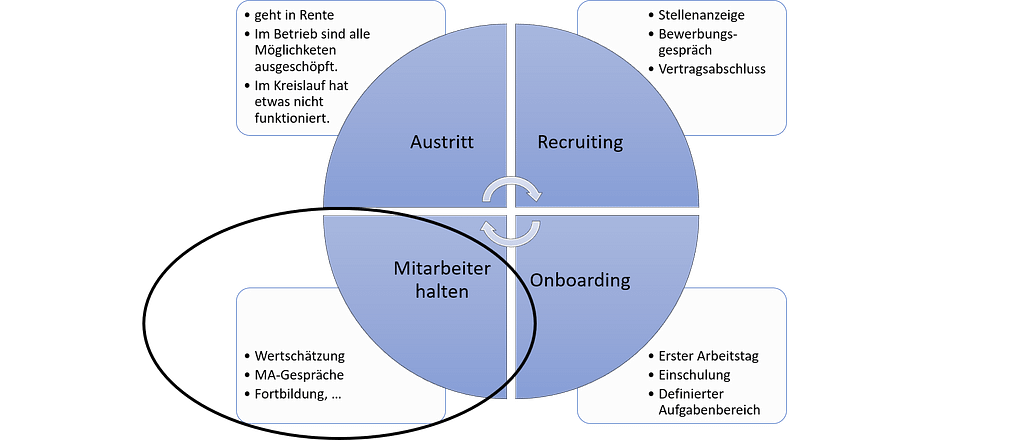
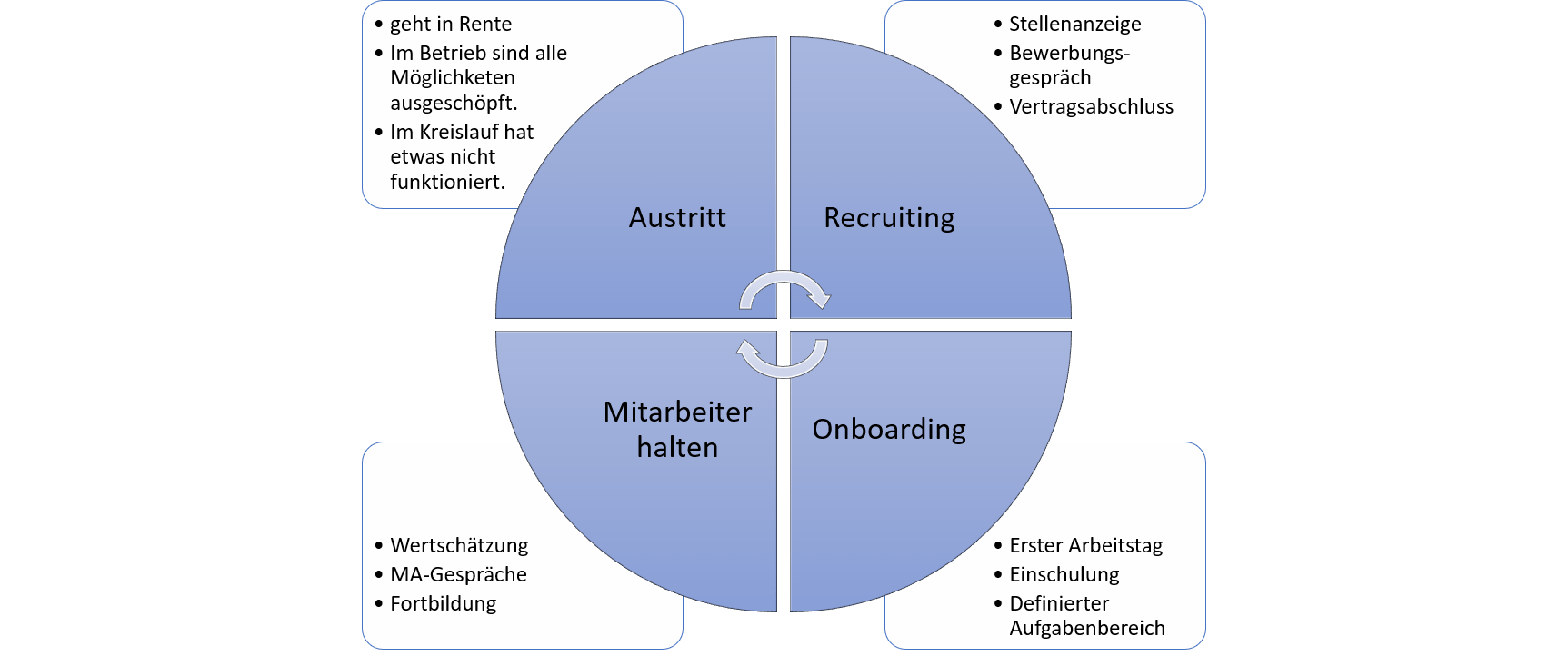
There are often many different reasons why an employee leaves, some of which I have noted in my employee cycle:

Employee cycle

The be-all and end-all at the end of the employment relationship, the exit interview.

The exit interviews I have had so far, whether as an employee or as a manager, have all been very valuable & extremely enriching.
What was the reason for this?

The exit interview from the employee's perspective:

  • The person I had my exit interview with was not my direct superior.
  • The setting of the interview was pleasant and in a neutral place.
  • There was a feeling of discretion and two open ears.

As a manager or supervisor, be aware that the last few days at work can be difficult for your employee, especially for employees who show great commitment, motivation and stamina. Even if you do not agree with your employee's dismissal or things have happened that were not what you expected, take the time for a final discussion.

The exit interview from the manager's perspective:

  • Initially an effort, but GOLDWORTHY.
  • It pushes your leadership skills to the next level.
  • The employee's input is often crystal clear & well-intentioned.
  • Your ability to think outside the box is challenged and encouraged.

If the situation with your employee is still emotionally charged, have the exit interview conducted by a neutral person, e.g. the contact person in HR. Or have the contact person in HR join the discussion so that the framework is maintained and the outcome is positive for both sides.

The input you receive from an employee who has known your company for a few months or even years is extremely valuable.

Suggestions for improvement are addressed. Tips for process optimization are mentioned. These usually come to the surface in employee surveys or appraisal interviews, but usually "only" in portions. The most honest and open words are spoken at the exit interview, as the employee has nothing more to lose.

Please note the following during the exit interview:

Even if your employee leaves the company, they have the right to be heard and to receive your attention. Remember, you probably hired this employee for a specific reason and probably promised them one or two things. Address these points and be open and honest with your employee. You are just as much a part of their journey at your company as they are.

(Working) life is a give and take.
It always takes two people to make a "relationship" work.

The decisions that are made during the course of a working relationship are not always comprehensible to employees and managers, but there is a background to everything and it only comes to the surface when you talk to each other.

Good luck with moving outside your comfort zone & optimizing.

Best regards
Kathrin Fuchs

goldWERT.tirol

Sustainable leadership and work.

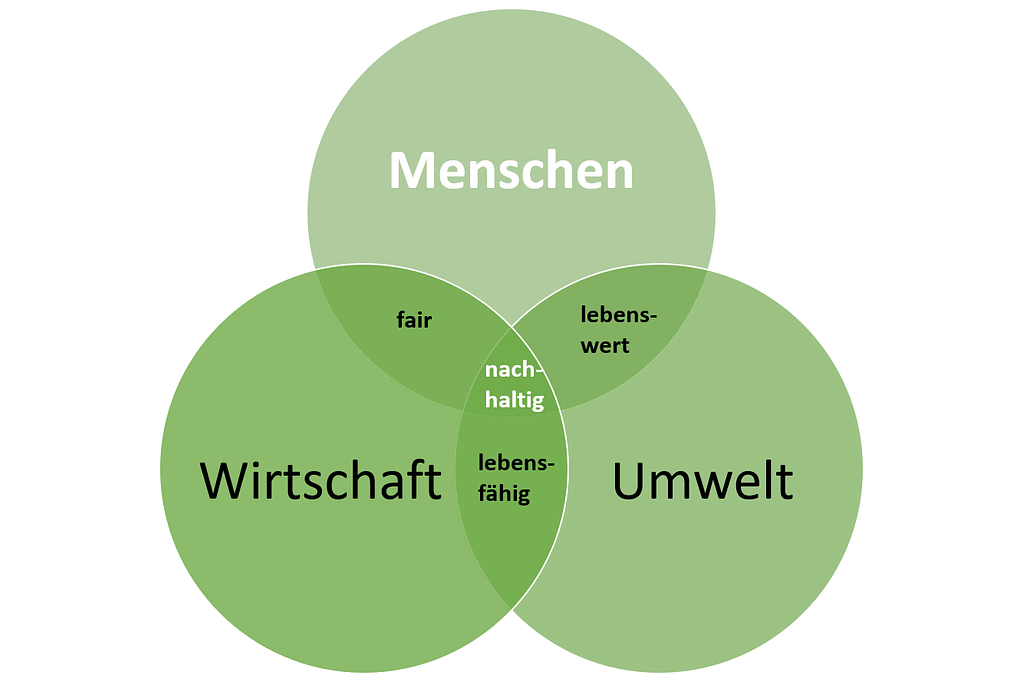
Michael Stoll's 3-pillar model has become established in the corporate sector. This states that the pillars of ecology, economy and social affairs support sustainable development. The following interpretation is one of my favorites, as it is the most expressive for me:

If you look up the word "sustainability" in the dictionary, you will find the following definitions:

  1. Long-lasting effect
  2. Use of forestry: forestry principle according to which no more wood may be felled than can grow back.
  3. Use Ecology: Principle according to which no more may be consumed than can be regrown, regenerated and made available again in the future.

There is nothing in the dictionary for social = people. I would like to add this below.

Sustainable personnel development

My previous blog posts were about recruiting and onboarding. The first two steps in the employee cycle are mainly about the start of a new employee.

Employee cycle

ATTENTION: When recruiting and onboarding, also think about those employees who are already with the company. Employees who have been with the company for more than a few months or perhaps even years, and who do so with perseverance and enthusiasm. They are the heart of your company.

Sustainable leadership and work is made possible through recurring discussions, events, feedback meetings, further education and training, team building and employee surveys. These are just a few examples of how you can get your employees on board and motivate them in the long term.

The important thing is ... :

  • Take your employees seriously.
  • If you are presented with ideas and requests, take them on board.
  • Respond to suggestions for improvement.
  • Address conflicts, this is where the greatest potential for growth lies dormant.
  • Provide prompt feedback (1-2 weeks) on all the points just mentioned.

If an employee gives you honest & open feedback, this is MORE IMPORTANT than any innovative idea from an external specialist. Your employee knows the company better and experiences processes on a daily basis.

Take your employees seriously & involve them in your growth.

Listen - Plan - Implement - Retain employees.

Good luck with GROWING together.

Best regards
Kathrin

_ Retaining employees is worth its weight in gold.

Has your employee come to stay?

It is 23.06. The contract with your new employee has been signed. He will start his new job on 01.09. There is still a lot to do before 01.09. But what?

AFTER recruiting is BEFORE onboarding.

Onboarding - what does it involve?

Before the first working day, there are a few things you need to do:

  • Define task area
  • Interfaces with other team members/departments
    (define work "framework")
  • Workstation (adjustable desk yes/no, 1 screen or more, etc.)
  • Technical equipment (laptop, access, passwords, etc.)
  • Who takes care of school enrollment? (Resource ZEIT)
  • Send general information about the company in advance by e-mail/post (arouse the employee's interest and anticipation)

What should the first working day include?

  • Welcome
  • Guided tour of the house
  • Introductions to colleagues
  • Life-sustaining measures (eating, drinking, toilet)
  • Show workplace (familiarization with the system)
  • Describe your area of responsibility
  • Training on the first few days is extremely important. (Take TIME & build CONFIDENCE)

End of the first working week / start of the second working week (depending on the job)

  • Feedback discussion (e.g. over a coffee/separate room)
  • What do you already know? Where can I support you?
  • Are you familiar with the connections?
  • What don't you understand so well yet?

The feedback meeting is not about evaluating the employee. It is about finding out whether the employee feels comfortable with their tasks, understands them and how they can be supported so that they can do a good job in the long term.

Knowing how things are connected and who to ask is essential for a good start in the new working world. There is nothing more tedious for a new employee than not receiving any information, being sat in front of a screen, and being told to "get started." This only works in a few professions, and even less so in the current job market than in the past. Moreover, we are all human beings and are grateful when someone takes the time to welcome us on board.

Several people can also train a new team member. It is important to ensure that it is agreed who will train what and that all important tasks of the new employee are covered.

LAST BUT NOT LEAST in the employee cycle

  • BE TRANSPARENT
    New employees and "old" employees should know what "the new guy" does. Then everyone feels good when a new team member starts.

By planning your employee's first day of work in advance, you take the pressure (and time) off yourself. This makes ONBOARDING more enjoyable for your team, both old and new members, and saves a lot of TIME.

Have fun trying it out.

Kind regards
Kathrin Fuchs

_ Retaining employees is worth its weight in gold.

Where do you see yourself in 5 years?

... what do you hope to hear from an applicant when you ask this question? Or rather,
... what do you really want to hear?

Honestly?... I have been working for 18 years, I am open and direct, an ambitious employee and manager, and now self-employed, but I have always felt uncomfortable when asked, "Where do you see yourself in 5 years?"

Why? What was going through my mind...

As an applicant – depending on age and job:

  • "Phew, what does the future supervisor / HR manager want to know from me?"
  • "No matter what I say now, it just comes across the wrong way."
  • "If I say now that I am ambitious and highly motivated,
    then he might fear that I want his job."
  • "If I say, oh never mind, I'm completely flexible and take everything as it comes. Then he thinks to himself, she's totally boring, I'm sure nothing will happen and she doesn't have any goals, so she won't be able to increase her turnover."
  • etc.

I was ultimately able to convince my future supervisors and show them that I am motivated, committed, persistent, and capable of significantly increasing sales. But the job interviews were always a big challenge for me.

As a supervisor and manager:

Again, it wasn't easy for me to ask the question "Where do you see yourself in 5 years?". That's why I started to formulate the question differently...

  • "What will it take for you to still be with us in five years' time?"
  • "What needs to happen for you to still be with us in a few years' time?"
  • "What was the reason you weren't at the last few companies for so long?"

This rephrasing & the use of "DU" made it easier for me as a supervisor to ask the question and the applicants found it easier to answer the questions.

My employees have stayed longer than the average in the company (80 employees). The job interview was the beginning & of course other components & circumstances played into the lower fluctuation in my area, but it still contributed to my employees deciding in favor of me as a person & the position in the company.

And let's be honest, why does an employee join a company or choose a particular company? Because they had a good conversation with you as a person or they are on the same wavelength. That's why many colleagues in the areas of coaching & human resources speak of introductory interviews & no longer of job interviews.

The labor market is now an applicant market.

  • Use the time you have with an applicant and ask questions that start with WHAT, HOW or WHICH.
  • Ask OPEN questions as much as possible so that you show interest in your counterpart.
  • Use fewer CLOSED questions (answer: YES or NO).
  • Give your applicant room to answer.
  • Be honest & open & yourself.

Fake it until you make it ... does NOT work here anymore.

After a few weeks at the company, the employee realizes that they are not in the right place and leaves after one or more employees have trained them. And that costs time, effort, and energy.
It holds everyone back. Processes are slowed down.

If you have an abundance of time, then this is acceptable, but if you want to work efficiently and focused on a goal, it is tedious, exhausting and totally demotivating for all your employees, especially if it happens several times in a row.

A good job interview does not guarantee that every employee will be a good fit for the company and stay forever, but it is the basis for a healthy corporate culture, which is the foundation of the Human Resources Department.

Good luck with your upcoming introductory meetings.

Sincerely,
Kathrin _ goldWERT

P.S.: If you notice anything unusual in the applicant's facial expression, ask if there is anything unclear. Be empathetic and attentive.

The most valuable asset - our employees.

The coming and going of employees is a natural process. Employees want to get to know different things, learn new things and acquire additional knowledge. As a manager & supervisor, you want a good employee to stay longer ...

employee-retention-employee-retention-employee-circle-employee-development-gold-value
Employee cycle (process)

... but how do I move an employee away from the job advertisement to decide to stay with my company?

Retain employees.

Many companies deal with the topic of recruiting and try a lot to get the employee to sign the contract and really start on the agreed date. BUT ...

- What happens once the employee has signed the contract?
- As a manager or supervisor, how do you prepare for your employee's first
working day?
- What does onboarding look like?
- etc.

Output: The most valuable asset—the employees.

I know these are a lot of questions. Over the next few weeks, I will be happy to introduce you to the possibilities of the employee cycle. The tools take time, but believe me, it's time well spent. Your employees will stay longer and you will save yourself a lot of costs and effort in many different areas.

If you have any questions for me, or if you have acquired a taste for keeping your employees in the company for longer, please contact me.

Sincerely,
Kathrin _ goldWERT

Intersection of success: Where management, employees, and customers meet.

It is a matter close to my heart to create a WIN-WIN-WIN situation in my coaching sessions.

What do I mean by WIN-WIN-WIN?

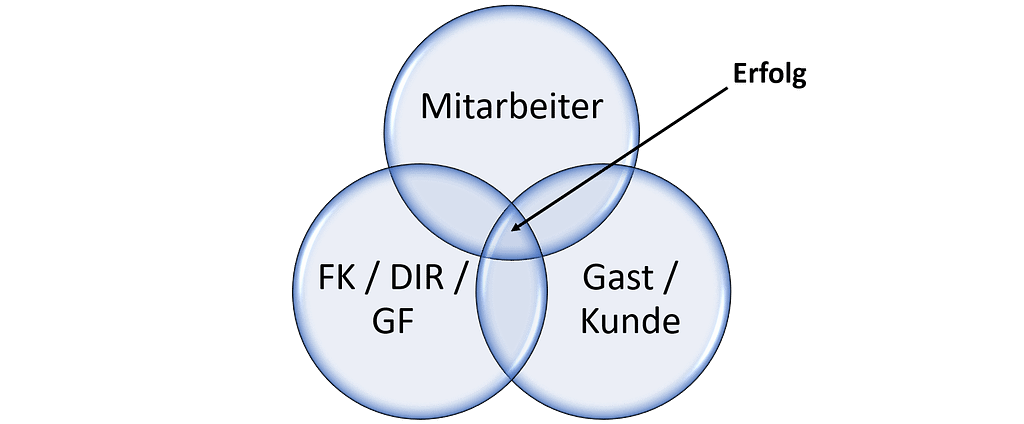
A service company can only be successful if 3 cycles, and in this case also participants, work together. These would be:

  • Management level: Manager (FK), Director (DIR) or Managing Director (GF)
  • Employees
  • Guest or customer
Intersection of success

Being successful - what does that mean?

For me personally, "being successful" was always defined as follows from the perspective of the employee and the manager:

  • Enjoy working
  • work motivated as part of a team
  • be able to design my tasks individually
  • receive appreciation that I always give 100% and more.

As a customer, I enjoy buying products with quality and good value for money. I enjoy being advised by a motivated, honest and open employee. I accept tips and often buy more than I initially thought. That's what makes good service for me.

When the three cycles are functioning well, synergies arise.

If the employee enjoys their work, they will pass this on to the customer. In the end, the management is also happy because the employee enjoys working for the company and turnover increases. ...

... This brings us to the WIN-WIN-WIN situation-> the intersection of success.

How can you achieve lasting success?

You can only achieve the intersection of success permanently and sustainably with brain and heart. Or as I like to call it ... the give and take in the world of work.

Be open to your employees' ideas and give them a healthy amount of (free) space and responsibility; this is how you create a pleasant working environment. Your employees will be happy to come to work on Monday and will enjoy working for your company in the long term.

Output: Intersection of success.

The management level, the employees and the customers are three separate cycles that meet where the company is most successful. And success is the goal of a company. Isn't it?

I wish you every success.

Sincerely
Kathrin Fuchs

_ goldWERT✨
_ goldwert.tirol