Successfully embracing and implementing change.

Change is inevitable in any organization: market conditions shift, processes evolve, and people grow. What matters is not whether change happens, but how it is embraced and implemented. Successful transformation is not a leap but a process—one that involves clear roles, open communication, and a consistent approach.

The following section outlines a practical approach that provides guidance: from recognizing your own role to achieving lasting progress as a team.


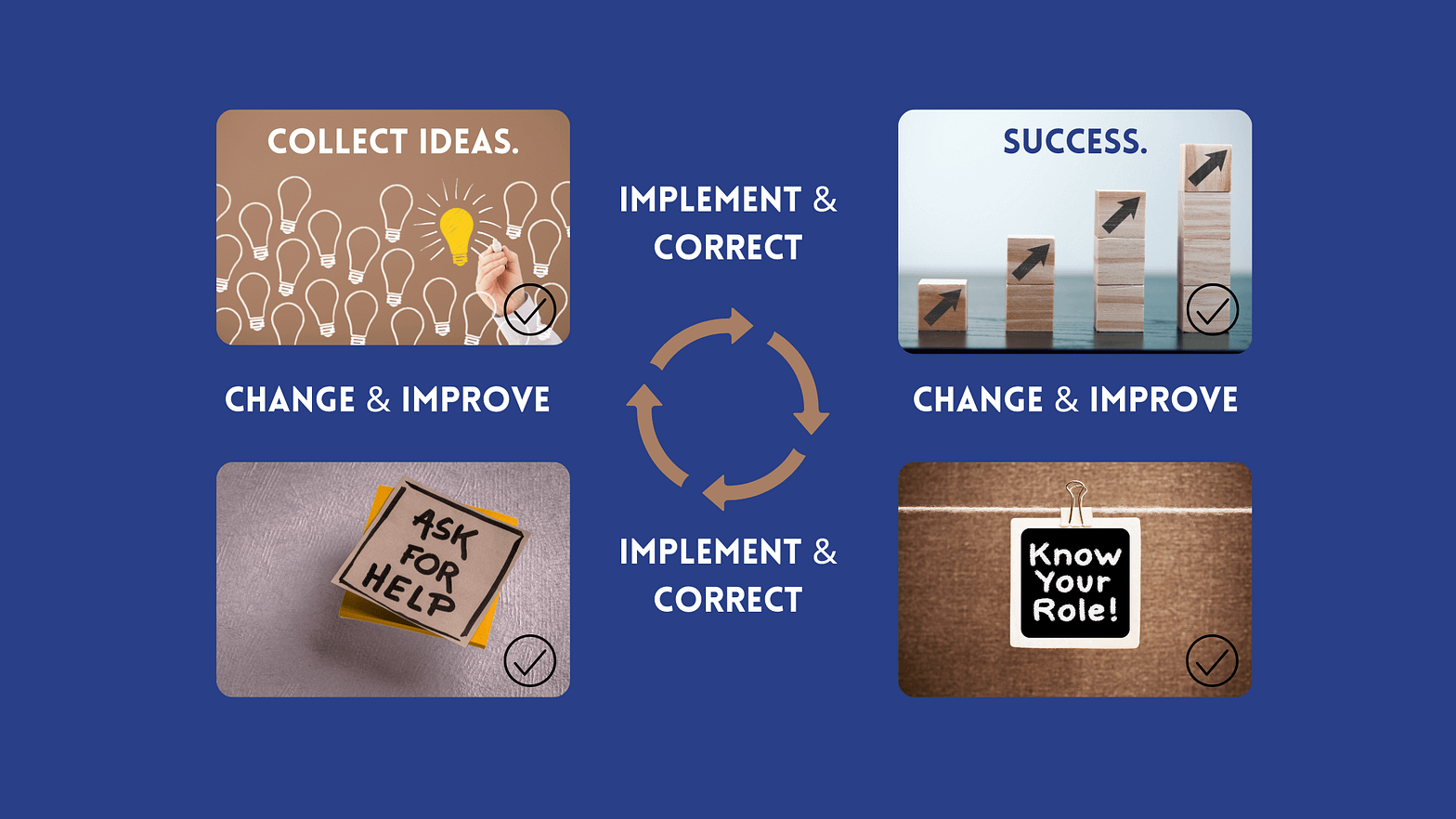
1. Know your own role

Change rarely fails because of a lack of ideas. More often than not, it fails because of unclear responsibilities and the fact that no one fully understands what role they actually play in the change process.

That's why it all starts with the question:

  • What role do I play in this process / on this team?
    • Am I a source of inspiration?
    • Who is driving the implementation?
    • A supporter on the team?
    • Who should I contact if I have any questions?
    • Female decision-maker or male decision-maker?

When roles are clearly defined, it creates a sense of psychological safety: employees know who makes decisions, who provides support, and how feedback is given. This reduces friction and prevents responsibility from “falling through the cracks.”

A helpful tip: Define“who does what”and how decisions are made and communicated. This helps keep change under control.


2. Being able to ask for help or accept help

Many leadership teams and teams believe that change must be achieved “on their own.” But real progress happens when support is actively provided.

Giving help is a leadership skill—and accepting help is a sign of maturity. The two go hand in hand.

In practical terms, this means:

  • Get feedback early on, not when it's too late.
  • Keep communication channels short: Who can be contacted, when, and how?
  • Provide resources (time, prioritization, support, and clearly defined responsibilities).
  • Make asking questions a normal part of the process: “If something isn’t clear, it’s a sign that something needs clarification, not a failure.”

Those who are open to help move things along more quickly. And those who are able to accept support reduce stress, improve quality, and increase the likelihood that changes will actually take root in everyday life.


3. Gather ideas from employees

Employees aren't just "doers." They are the experts in day-to-day operations.

That’s exactly where the best insights come from:
What really works? Where are the bottlenecks? Which processes take up time without adding value? What obstacles have been overlooked so far?

To ensure that ideas don't fizzle out, we need structure and recognition:

  • Actively seek out ideas (e.g., in meetings, feedback sessions, weekly gatherings)
  • Ask specific questions: What went well? What was difficult? What would be a sensible next step?
  • Prioritize: Not every idea can be implemented right away—but every idea deserves to be clearly categorized.
  • Ensuring transparency: What happens to the contributions? What decision was made, and why?

IMPORTANT: Employees don’t just want to be heard. They want to see their ideas translated into decisions. That is exactly what strengthens commitment and team spirit.


4. Successfully embracing and implementing change

Now comes the crucial phase: actually getting the change underway and making it sustainable.

Successful implementation is based on three principles:

a) Change requires a process-oriented approach—not an “immediate switch”

Expectations must be managed carefully: change doesn’t happen overnight. Depending on the project, its complexity, and its duration, it requires planning, practice, and course correction.

That is why communication is also part of the implementation process:

  • What steps come next, and when?
  • What is realistic in the short term?
  • What will be tested in the medium term?
  • What aspects are deliberately left unchanged because they have proven effective or are part of the company culture?

This clarity prevents frustration and keeps motivation high.

b) Implementation follows reflection—but not in an endless loop

Reflection is necessary to assess the direction we are heading in. But it must lead to action.

A good goal is:

  • reflect on,
  • prioritize,
  • decide,
  • implement,
  • check,
  • and further develop.

This leads to progress rather than endless debate.

c) Change must be put into practice

A change is only successful when it becomes part of your routine:

  • in day-to-day operations,
  • in handovers,
  • in votes,
  • in our interactions with one another,
  • and in the way decisions are made.

This is achieved when leadership provides consistent support, facilitates feedback, and highlights successes.


Success is reflected in the numbers.

Whether it's profits, employee turnover, or sick leave: numbers aren't cold and impersonal. They serve as a mirror. They show where the system is currently working and where it needs improvement.

  • Consistent profits are achieved when processes run smoothly and decisions are made in a timely manner.
  • Low turnover occurs when employees feel that their roles are well-defined and that they are being effectively managed.
  • Sick leave is often lower in workplaces where workload, leadership, and working conditions are well-balanced.

Those who talk only of “optimization” but fail to consider success lose their way. Those who focus on success can steer their course with purpose.

At the end of the Improvement Circle, there is more than just a “summary.” It is the moment when change becomes visible—to everyone.

Success is reflected in employee retention.

Employee retention is more than just an HR metric. It’s culture in everyday terms. A team stays together when it understands the purpose, experiences growth, and knows where it stands.

In this context, success specifically means:

  • Tasks are clear, roles are defined.
  • Feedback is provided before frustration sets in.
  • Services are utilized, not merely demanded.
  • Leadership that supports—rather than just supervising.

After all, people don’t stay just for the benefits. They stay because they realize: “Here, who I am matters—and my work makes a difference.”

Success is the result of teamwork.

Good teamwork can sometimes seem unspectacular. But that is precisely what makes it valuable. Collaboration becomes strong when conflicts are addressed rather than swept under the rug—and when differing opinions lead to sound decisions.

Successful teamwork means:

  • Verification replaces assumptions.
  • Responsibilities are clearly defined, not blurred.
  • Reflection leads to action, not to endless discussions.

And yes: The same applies here—progress isn’t achieved by “thinking even more,” but by “making clear decisions and sticking with them.”

At the end of the Improvement Circle: Celebrate successes and ensure lasting impact

This involves three steps:

  1. Celebrate Successes
    Every improvement is proof that the process works. Recognize progress in concrete terms, not just in general.
  2. Communicating Results
    Employees should know:
    • Where are we at right now?
    • What have we changed together?
    • What's the next step?
  3. Explain the joint trip
    Stating expectations clearly and early on prevents misunderstandings:
    • Change and improvement are a process.
    • Changes take time—and are implemented gradually.
    • Certain things are deliberately kept the same if they have proven effective and fit in with the company culture.

In closing: Saying “Thank you for your ideas” isn’t just a matter of politeness. It’s a form of leadership that fosters engagement and creates a sustainable cycle.


Output – Successfully embracing and implementing change means:

  • clearly understand one's own role,
  • Allow help,
  • Actively incorporate employees' ideas,
  • Manage implementation using a process-based approach,
  • and ultimately make progress visible.

Change is seen as a source of motivation when processes are refined and improved with clarity and energy, and through collaborative effort within the team.

Success is an integral part of sound business management. Whether measured in numbers, employee retention, or teamwork, success shows you whether your direction is sustainable and makes progress tangible. When leadership uses success as an opportunity for improvement, it creates a work environment where people want to stay and grow alongside the company in a financially healthy way.

If you have any questions about implementing improvements and changes or about specific process areas, please feel free to contact goldWERT _ events & coaching.

Sincerely,
Kathrin Fuchs

Owner & Business Coach at goldWERT

Brainstorming as a team: Seeing change as an opportunity

Today’s installment in the goldWERT series “Seeing Change as an Opportunity” focuses on a key element that makes all the difference in any improvement process: brainstorming ideas as a team. Good ideas rarely happen by chance. They emerge when all perspectives are brought to light and everyone views change as an opportunity to learn. That’s when “we really should…” turns into real progress.

What should you keep in mind to ensure that ideas actually emerge?

First, you need psychological safety. No one should be afraid of being “wrong” with a suggestion. Ideas can be tentative. Second, you need clarity: What exactly is the goal here? Without a clear focus, brainstorming quickly turns into a general venting session. Third, structured facilitation ensures that everyone gets a chance to speak and that it’s not just the loudest voices that dominate.

How can ideas be collected?

Use a simple framework that allows you to take action quickly. For example, with guiding questions:

  • What is already going well—and how can we build on that?
  • What's the biggest challenge right now?
  • What is the likely cause of this?
  • What small idea could we try out without having to completely overhaul everything?

It is also important to understand the roles within the team. This allows each person to make a meaningful contribution: whether through process knowledge, the customer’s perspective, technical capabilities, risk assessment, or implementation planning.

How are ideas put into practice?

Putting ideas into action is key to success. That’s why, once you’ve gathered them, you need to clearly prioritize them: Which idea offers the greatest benefit while remaining realistically feasible? Implementing ideas also involves testing them out, so briefly define the following:

-> Who will do what by when?
-> How will we measure success?
-> When will we evaluate the results?

And this is exactly where the cycle becomes clear: gather, test, evaluate, refine. Change isn’t a one-time event, but an ongoing process of development. If you actively shape this process, you’ll become more successful as a team, step by step.

Sincerely,
Kathrin Fuchs

Executive Coach
goldWERT _ events & coaching

Click here for the main article, “Successfully Implementing Change as a Team.”

Strengthening team culture: Accepting and offering help

Working together for success: Seeking help is not a sign of weakness, but rather a sign of strength and strategic thinking. An open and communicative team recognizes that everyone can benefit from the support of their colleagues. When you ask for help during the improvement process, you not only demonstrate your willingness to collaborate, but also promote dialogue within the team.

1. Encourage open communication

One of the most important prerequisites for asking for help is a team culture of open communication. When team members feel safe to express their weaknesses or uncertainties, the exchange becomes more constructive. By openly addressing challenges, you encourage others to do the same. Every team member should feel that asking questions and accepting help are not only acceptable but also desirable.

2. Accept support

Asking for support also means accepting that help. When you ask for support and receive it, be open to the ideas and solutions that are offered to you. Incorporating different perspectives can enable new approaches to solving problems. Often, the best solutions are the result of teamwork, as different points of view come together.

3. Choose appropriate formats

Choose appropriate formats for requesting help. This means creating simple and low-threshold opportunities, whether through regular feedback sessions, short check-ins, or informal conversations, which individual team members can use to ask for or offer support. In this way, "a helping hand" becomes part of normal everyday work rather than an exception.

4. Provide constructive feedback

When you ask for help and receive feedback, it is important to respond constructively. Thank the person for their support and reflect on their suggestions. This not only shows appreciation, but also encourages further exchange within the team and motivation to achieve future goals.

5. The continuous development process

Habit rather than exception: Improvement is not a project with an expiration date, but an ongoing process. Make regular reflection routines a habit. This can be at the end of a project, once a quarter, or after another significant milestone for your team/company. Use the insight cycles to adjust roles, optimize processes, and further develop support systems. Small, continuous steps bring about lasting change.

Output: Strengthening team culture: Accepting and offering help

Asking for and offering help is an essential part of any improvement process and an important component of successful teamwork. The willingness to seek and accept support not only leads to better solutions, but also strengthens team spirit and camaraderie. By establishing an open and supportive team culture, asking for help becomes a strategic tool that promotes efficiency and collaboration. Remember: working together makes many things easier and more efficient, and you are stronger in many ways.

Asking for help is the catalyst for real progress. By defining roles clearly, addressing problems courageously, seeking support on an ongoing basis, systematically gathering ideas, and consciously celebrating successes, you can transform challenges into growth opportunities for your team.

Make helping others the norm, and individual efforts will turn into collective strength, keeping your team constantly evolving.

Good luck strengthening your team culture.

Sincerely,
Kathrin Fuchs
Executive Coach _ goldWERT _ events & coaching

Click here for the main article, “Successfully Implementing Change as a Team.”

Role distribution within the team: advantages for motivation and flexibility

Structure creates clarity, and clarity creates action and success.

The importance of a clear division of roles

Imagine an orchestra.
Each instrument has its own role to play in creating harmonious sound and a structured overall picture. The same is true in a successful and focused team. Every role and every task is essential. Clear roles reduce misunderstandings and prevent tasks from being duplicated or not completed at all.

In strong teams, it is no coincidence that things run smoothly: every team member knows their role, understands which responsibilities fall within their own area of responsibility, and accepts the defined distribution of tasks.

"Yes, I know my role in the team" is more than just a statement. It is an attitude that promotes efficiency, focus, and employee satisfaction.

Why understanding roles is important.

Structure provides orientation. When everyone knows what to do, there is less overlap, less friction, and more certainty. Questions such as "Who is responsible for decision-making?", "Who provides the analysis?", and "Who is responsible for implementation and communication?" are clearly defined through the distribution of tasks. Defining roles within the team reduces duplication of work and preserves resources where they are needed and can have the greatest impact.

Specific advantages of the distribution of roles and tasks

Here are some key benefits:

Efficiency and quality in a team

Tasks are completed in a targeted manner and without delay by the person responsible. This ensures that the person with the most knowledge in this area completes the task efficiently and to a high standard.

Focus on your own strengths

Employees can focus their energy on priorities that they have chosen themselves or agreed to, and complete them quickly and correctly. Focusing on their own tasks gives employees decision-making authority. Work processes are accelerated right from the start, and customers or colleagues can be helped quickly and directly by the person responsible.

Delegate responsibility and maintain flexibility

Tasks can be assigned and misunderstandings can be quickly corrected. In addition, learning processes can be accelerated and flexibility increased because time reserves are created within the team.

Mutual motivation and support

The effect is immediately noticeable, as employees act confidently and are more motivated. Recognition for completed tasks goes directly to the right person. And if a request goes to the wrong person, it can be forwarded immediately to the person responsible.

How roles are clearly defined

  1. Goals first: Start with the common goal. Roles arise from what needs to be achieved.
  2. Write down tasks: Put responsibilities in writing; they can be brief and concise.
  3. Clarify expectations: Discuss performance standards (quality, deadlines, interfaces).
  4. Name interfaces: Define who communicates with whom and when handovers take place.
  5. Agree on flexibility: Roles are stable, but not rigid. (Temporary) adjustments should be possible for peak periods, special projects, or changes in the team.

Practical examples from everyday working life

  • At the hotel: The receptionist handles check-out and informs housekeeping of the guest's departure; housekeeping plans room cleaning based on this information rather than guesswork. This means that no one has to do the same work twice and the room is available for check-in as soon as possible.
  • In the restaurant: The service manager coordinates reservations, while the shift manager creates the corresponding duty rosters. Coordination between the two positions is essential.
  • For projects (across all industries): One team member is responsible for resource planning, another for quality control, so deadlines and quality run in parallel, not sequentially.

Live the roles, and you will succeed in implementing them.

  • Regular reviews, short and focused: "What went well?" "Where are the sticking points?"
  • Feedback culture and constructive feedback protect against the incorrect distribution of tasks.
  • Clear decision-making processes, "Who decides in conflicts?"
  • Recognition of visible contributions: Praise for taking on and fulfilling roles strengthens the culture.

Remain realistic and maintain communication

Clarity does not replace the need for cooperation and communication. Interfaces require coordination; sometimes roles need to be expanded at short notice. It is crucial that such changes are made consciously and transparently, not out of habit or ambiguity.

Reflect and adapt

Take time regularly to reflect on your role and contribution to the team.

  • Am I satisfied with my participation?
  • Are there areas in which I would like to grow?
  • Get feedback from your colleagues. This can help you gain insights and better understand and shape your role.

Output – Role distribution within the team: Benefits for motivation and flexibility

"Yes, I know my role in the team" is a simple sentence with a big impact. Clarifying roles reduces duplication of work, creates focus, and increases the speed at which tasks are completed. For managers and team members alike, it is important to provide structure, clarify expectations, and make responsibilities visible. This not only makes teamwork possible, but also makes it more efficient, motivating, and successful.

Click here for the main article, “Successfully Implementing Change as a Team.”

Sincerely,
Kathrin Fuchs
Executive Coach _ goldWERT _ events & coaching

Successfully implementing change as a team

A new year has begun... Yes, the famous resolutions, etc... but change can be made throughout the year. Here are some hints, tips, and tricks for times of change.

See change as an opportunity.

Change can be described as a transformation, a redesign, or an improvement, advancement, or expansion of something. In modern German, the term "transformation" is used. Personally, I prefer to stick with the meaning "a change = an opportunity."

I wouldn't take it so seriously with: "Uh, it's a new year, I have to change something right now... no, you can always start changing something. You have to be ready for it; you don't need December 31 or January 1. Instead, you need your willpower and a little courage, and often a "dead end" where you just want to get out and then push yourself to improve something.

We all want improvements, and we have nothing against them. That's why we stick to opportunities and improvements, because the word "change" alone discourages us from doing things differently than before. It's like the term "executive coaching." I usually refer to it as executive development, because everyone wants to develop themselves further, but many don't want to be coached. 😉 It's all a question of word choice and interpretation.

But how do I bring about change in a team?

In a team, it usually works no differently than when you work alone.

Ask yourself:

  • What is stopping me from changing something?
  • What would I need to tackle the change?
  • Who can help me improve/change?

Once you have answered these questions, it is usually quite easy to apply the answers to your team. Believe me, each of your colleagues and each of your employees has similar reasons for self-doubt or bad experiences when trying something new. This is one of the reasons why many people shy away from the word "change" and everything that goes with it.

However, most of us know that change can bring about many good things, wonderful experiences, and successes. That's why questions such as

  • What bad things have come out of my latest change?
  • What good has come out of my latest change?

... very appropriate and helpful for reflection.

Change in the team

The best way to initiate changes in the team is to discuss them together in a meeting, a feedback session, or a weekly setting. The best way to do this is to ask questions such as:

  • What went really well in the last project?
  • Where can we still improve?
  • And what do we need to do to be more efficient next time in this or that situation?

Honestly, reflecting, taking steps, and implementing improvements is essential in a team.

Why?

The team members stay on the ball, closely follow what is happening on a daily basis, and are aware of the goal and the steps needed to achieve it.

The only thing you mustn't do is interrupt the flow and reflect too much. Depending on the project and the length of the assignment, perhaps every 3 or 4 months. For shorter intervals or short projects, every 4 weeks... really always tailored to the project and when it makes sense.

Output: Successfully implement change within the team.

Improvements are desired in every team. The question is how much change is needed and what individual team members, management, and executives can contribute to this. It is important to talk about this, identify potential for improvement, and take active measures within the company. After all, if you ask for suggestions for improvement, e.g., in employee surveys, and then do nothing about them, you will end up demotivating your staff, and motivated employees will increasingly consider working elsewhere.

You want to initiate improvements with your team and employees and need external support to do so ...

Sincerely,
Kathrin Fuchs
Executive Coach _ goldWERT _ events & coaching

Appreciation and communication in hectic times

A guide for managers in the hotel and restaurant industry

Does this sound familiar? Even before the meeting starts, you find yourself glancing at the clock and wondering how you’re going to juggle your next urgent appointments, meetings, and deadlines. The pressure is often particularly high during the hectic pre-Christmas season. Long hours, packed restaurants, stressed-out guests—the demands of the hospitality industry are challenging all year round, but they often reach a “boiling point” during this time.

Appreciation as the key to cohesion

In stressful times, it can be easy to lose respect for one another. But especially now, when we are facing so many challenges, it is important to treat each other with appreciation. Respectful interaction is an absolute game changer and creates a positive working atmosphere in which all employees feel heard and understood.

When we show appreciation for each other, the pressure becomes easier to bear. Small gestures of recognition, such as a simple "thank you," can significantly improve a colleague's day. This not only strengthens team spirit, but also boosts motivation.

The importance of communication

Open communication is crucial in stressful times. Managers should maintain close contact with their team. Regular meetings, feedback discussions, and a willingness to listen are essential for identifying concerns and needs at an early stage. Being open to listening helps to avoid misunderstandings and strengthens trust in leadership.

Practical tips for leadership work

Here are three important, easy-to-implement tools for promoting respect and appreciation:

  1. Active listening
    Take the time to really listen to your employees. Often, simply being there and showing understanding helps. Active listening promotes trust and shows that you take your employees' concerns seriously.
  2. Plan days off in advance
    Long shifts and short breaks are often part of everyday life during the high season. Managers should therefore plan compensatory days off for their employees in advance. Flexible working hours and sufficient recovery periods are crucial to avoid overload and stress. Support your team in achieving a good work-life balance.
  3. Appreciation and motivation
    Regular feedback and small gestures of gratitude are important for maintaining your employees' motivation. Recognize the work they have done and show that each individual makes a valuable contribution to the team. A simple compliment can lift the mood and strengthen team spirit.

Output: Appreciation and Communication in Busy Times.

The Christmas and New Year period not only brings challenges, but also offers numerous opportunities to grow together. With the right support in employee development and an appreciative management style, managers can not only master stressful situations, but also create unforgettable experiences for guests.

Especially in these unusual times, it is important for hoteliers and hosts to create a respectful working environment. In the long term, not only employees but also the entire company benefits from a positive, appreciative culture, not to mention your guests.

If you have any questions about the hotel industry or preparing for stressful times, please do not hesitate to contact me directly or subscribe to my newsletter for further information, tips, and tricks on leadership.

Sincerely,
Kathrin Fuchs
Executive Coach _ goldWERT _ events & coaching

Thinking sustainability holistically within the company.

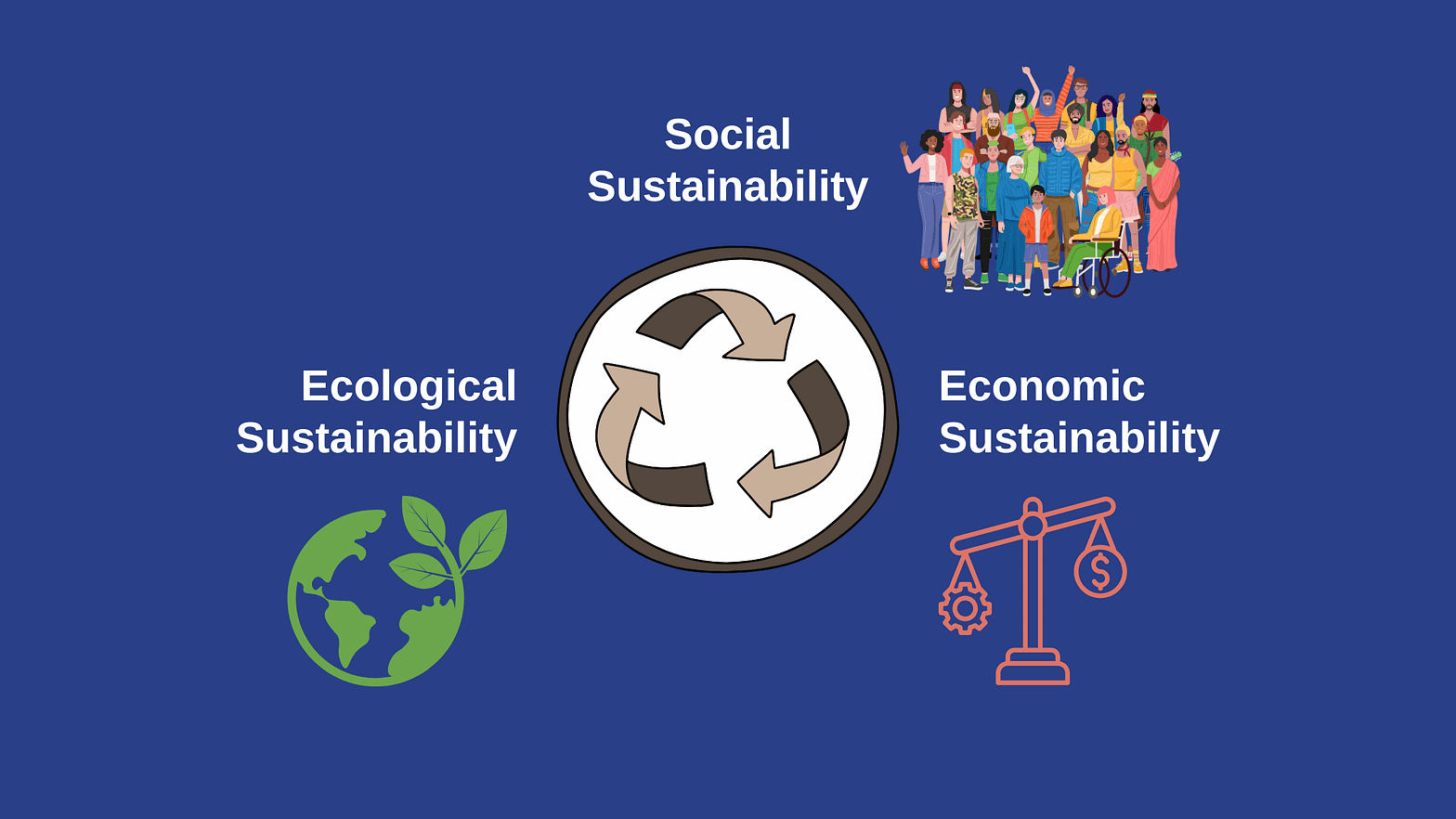
Sustainability is an entrepreneurial approach that is indispensable now and will be for decades to come. The three pillars of sustainability - economic, ecological and social - form the basis of a holistic concept that not only protects the environment, but also promotes economic success and social responsibility. Read the following article to find out how sustainable working is changing everyday life and which aspects managers should consider when implementing it.

The Three Pillars of Sustainability and Their Importance for Leaders.

Economy: economically strong and future-oriented

The economic pillar deals with the creation of profitable business models that achieve both short-term and long-term success. Sustainable companies consider not only profit, but also the environmental and social impact of their actions. This means working in a way that conserves resources, operating efficiently and maintaining strategic partnerships.

As a first step, managers should integrate sustainability goals into the corporate strategy. Investing in green technologies or innovative products can pay off in the long term and set the company apart from the competition.

Ecology: Responsibility for the environment

Environmental sustainability requires a more conscious approach to the consumption of resources. Companies that promote environmentally friendly practices such as recycling, using renewable energy and minimizing waste make a decisive contribution to the fight against climate change.

It is important to take concrete measures for implementation. For example, training courses on resource conservation can be held for employees to raise awareness of environmental challenges.

Social issues: focusing on people

The social pillar relates to the well-being of employees and responsibility towards society. A company that values social sustainability offers fair working conditions, promotes diversity and supports the community.

Managers should establish a corporate culture that fosters team spirit and appreciation. This can be achieved through regular feedback meetings, team-building measures and training opportunities. Satisfied employees are more productive and loyal, which has a positive impact on business success.

Sustainable impact in everyday working life

Sustainable working represents a fundamental change in operational procedures. It promotes a new way of thinking that prioritizes innovation and efficiency. The introduction of digital processes and communication tools can significantly reduce the consumption of resources. A paperless office or the elimination of business trips in favor of digital meetings are concrete steps in this direction.

In addition, the introduction of flexible working models can not only improve employees' quality of life, but also reduce the ecological footprint. Home office options, for example, reduce commuting and therefore emissions.

Recommendations for managers

As a manager, you should keep an eye on a few key aspects in order to run a sustainable company:

  1. Integration of sustainability goals: Set clear, measurable goals and integrate them into your corporate strategy. Regular reviews help you to recognize progress and make adjustments if necessary.
  2. Employee participation: Actively involve your employees in the process. They provide valuable ideas and suggestions that contribute to improving the sustainability strategies.
  3. Investments in green technologies: Prioritize investments in resource-saving technologies that combine economic efficiency and environmental awareness in the long term.
  4. Open communication: Share your sustainability strategy with all stakeholders to create transparency and promote trust.
  5. Appreciation and community: Create a culture that promotes appreciation and community. Targeted personnel development measures increase employee motivation and reduce staff turnover.

Output - thinking sustainability holistically within the company.

Sustainability is a corporate responsibility that has far-reaching positive effects. By integrating the three pillars of sustainability into your corporate strategy, you not only create a more sustainable working environment, but also position your company for the future in the market.

As a manager, you have the opportunity to actively make a difference. Invest in economic efficiency, take care of ecological issues and focus on social responsibility. The future belongs to companies that have the courage to act sustainably and focus on their employees.

If you have any questions about sustainable working or the integration of sustainable aspects into your company, please feel free to contact me.

Sincerely,
Kathrin Fuchs
Executive Coach _ goldWERT _ events & coaching

The advantages of reflecting together as a team.

Reflection is not just an individual process, but also plays a crucial role in the team. Reflecting together helps to optimize collaboration, strengthen individual team members and see the team as a whole. In this article, we take a look at how reflection works best in a team and the benefits it brings.

Why is joint reflection important?

Reflecting within the team creates space for honest feedback and promotes a culture of open communication. It enables team members to share their views, learn from each other and tackle challenges together. This joint retrospective and forward-looking approach not only strengthens trust, but also motivates employees to actively contribute to team development.

But what are the right questions to ask in a reflection?

The reflection should not be completely unstructured. Prepared questions help to start the discussion and cover all the important aspects. Here are some key questions to get your team thinking:

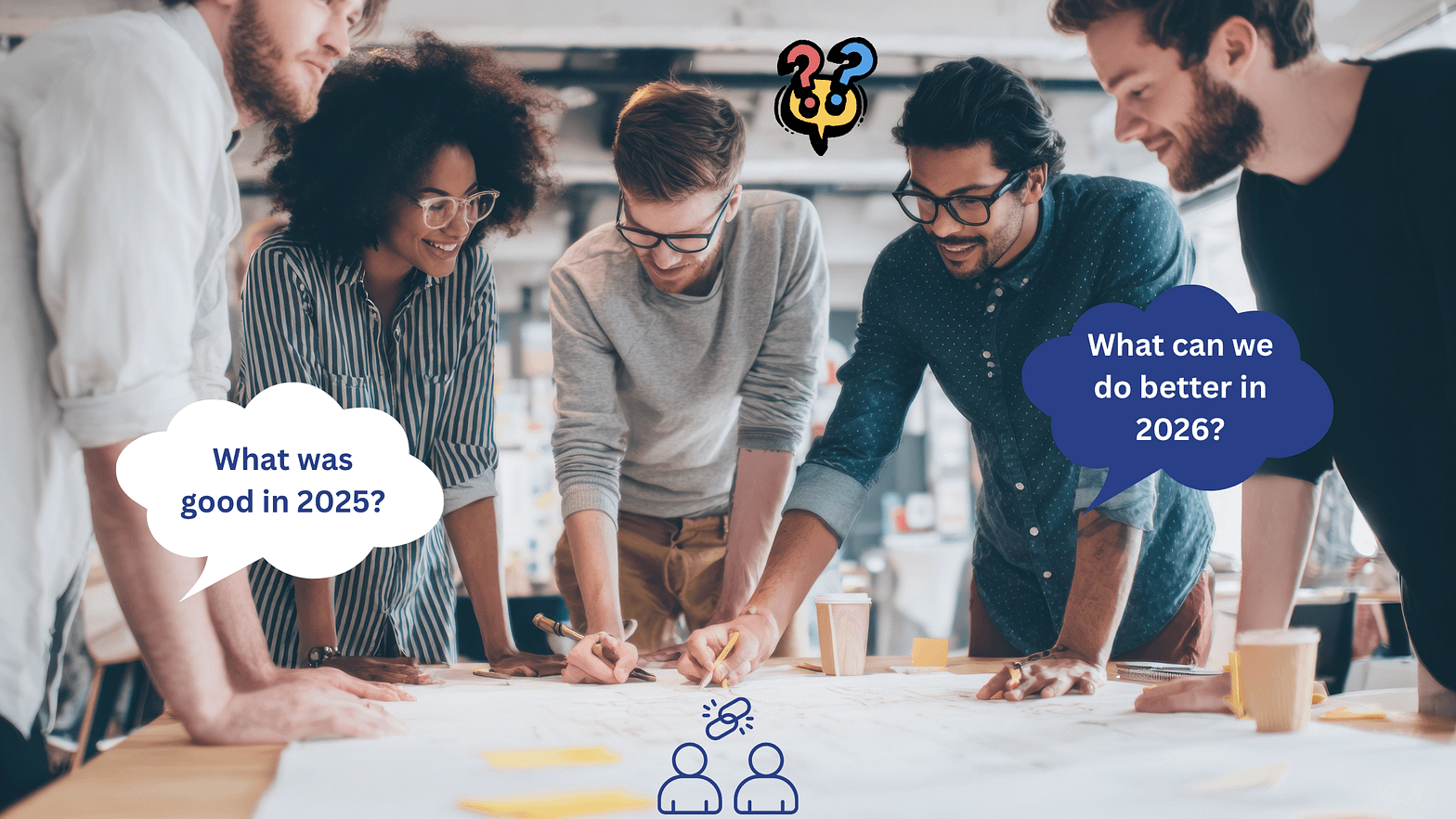
  1. What went well in 2025?
    • What successes have we been able to celebrate individually and together?
    • Which procedures have proven successful?
    • What do you personally remember most fondly?
  2. What could go better in 2026?
    • What challenges have you noticed?
    • Where and when did communication or the process flow get stuck?
    • What would you like for yourself and your team in 2026?
  3. What else do we take with us?
    • What have we learned from difficult situations?
    • What measures do we want to take in the future to improve our work?
  4. Are there any outstanding issues that you would like to address?

An open round at the end or, if there is time, at the beginning and end of each reflection is an absolute must from the goldWERT side in order to allow each person in the round to speak and be involved.

Advantages of reflecting together

Clarity and Focus

Joint reflection gives the team a clear overview of the current challenges and successes. This promotes a focus on critical issues and helps to (re)set priorities.

Efficient Collaboration

By understanding the different perspectives, teams can work together more effectively. Sharing experiences and insights leads to joint decisions, greater cohesion and better goal achievement.

Continuous Improvement

Regular reflection helps teams to recognize patterns in work behaviour. This enables them to work proactively on improvements, which ultimately leads to higher productivity.

Motivation and Team Building

Joint reflection creates opportunities to strengthen team spirit. Successes are not only personal successes, but also joint successes. Celebrating these successes motivates and promotes a positive working atmosphere.

The right timing for joint reflection.

The frequency of reflections should be adapted to the working rhythm of the team. An interval of three to six months makes sense. Larger reflections are particularly useful at annual or half-yearly intervals in order to recognize successes and set new goals together.

Output: The advantages of reflecting together as a team.

Joint reflection is an indispensable tool for working more efficiently as a team. It strengthens communication, promotes trust and contributes to continuous improvement. As a manager, it is crucial to encourage such reflection times and integrate them into everyday working life.

Remember that progress in a team depends not only on individual performance, but also on the ability to learn and grow together. Schedule times for reflection just as carefully as other important meetings. The benefits for your team and your company will be clearly noticeable.

If you have any questions or would like to discuss other topics related to effective team management, please feel free to contact me.

Sincerely,
Kathrin Fuchs
Executive Coach _ goldWERT _ events & coaching

Teamwork, team building and team coaching.

In today's world, teamwork is essential in a company. A strong team is not only more productive, but also more innovative and satisfied. At goldWERT _ events & coaching, we offer you the tools to strengthen your team and celebrate success together.

The power of teamwork

Teamwork means that every voice counts and every opinion is valued. An effective team works like a well-oiled clockwork, every part is important to move forward smoothly. Communicating clearly and openly promotes mutual understanding, which leads to better collaboration.

When team members work together, they can support and strengthen each other. Trust is the key to a successful team dynamic. When employees can rely on each other, an environment is created in which creativity and innovation thrive.

Team building: becoming strong together

Team building is more than just a few fun activities. It's about strengthening relationships within a team, fostering a positive company culture and getting to know each other better in order to understand each other. At goldWERT, we focus on individual team building programs that are tailored to the specific needs of your team.

Activities with added value

Joint activities, whether in the form of workshops, outdoor events or interactive training sessions, promote exchange and getting to know each other. These experiences weld the team together and create memories that strengthen cooperation in the long term.

Team coaching: Developing potential

Team coaching is a valuable tool for recognizing and promoting a team's strengths and potential. At goldWERT, we believe that every team has the ability to achieve great things, you just have to provide the right impetus and support each team individually.

Individual approaches for each team

In our coaching sessions, we analyze the dynamics of your team and identify areas that can be improved. Through targeted interventions, we help the team to define its goals and optimize collaboration. We are always at your side to find solutions that are individual and fit your team.

Better integration of employees

A strong team also means integrating new employees quickly and effectively. Our programs help to optimize the onboarding of new team members and make them feel part of the team right from the start. When employees feel comfortable from the start and realize that their opinion counts, the sense of belonging increases and the likelihood that the employee will remain loyal to the company in the long term. Good integration is crucial for employee retention and reduces staff turnover.

Output: Teamwork, team building, team coaching.

Together we achieve more. Teamwork is the key to sustainable success. Through effective team coaching, committed team building and a positive team culture, you create the basis for a productive and harmonious working environment.

Let us work together on your team and strengthen it - for a successful future. At goldWERT _ events & coaching, we support you with individual solutions so that your team can take the next steps towards success.

We look forward to accompanying you and your team on this journey.

Sincerely,
Kathrin Fuchs
Executive Coach _ goldWERT _ events & coaching

goldWERT insights: People & Variety in Hospitality, the Döllerer Family.

Do you know this? You yourself are changing, but there are colleagues, friends and companions who have been with you for longer than one job. You don't see these people every week, but when you do, it's like you've organized your first wine festival together. That's how I feel with the Döllerer family when we meet at a wine tasting or a gala dinner among tourism professionals. My contact person at events has always been Raimund Döllerer, who looks after the wine trade in Kuchl. It was through him that I got to know the other valuable outlets of the Döllerer family and other family members.

Döllerer's wine house and enoteca in Kuchl.

Not only are 400,000 bottles of wine from outstanding origins stored here under excellent conditions, but an enoteca, which definitely appeals to wine lovers, is also integrated into the wine house. You should definitely take a look at the wine library, because the selection of wines at Döllerers is a matter of quality and enjoyment. Not only Raimund is on the lookout for the best wines Europe has to offer, even on his vacations, but also his cordial and extremely competent staff.

There are several event highlights centered around wine and outstanding haute cuisine. My personal favorite is the Döllerer wine festival. In spring there is a wine festival outside Kuchl. And in the fall, the annual HEIMSPIEL wine festival in Kuchl and Golling. The motto of these wine festivals is "Discover. Taste. Enjoy." and are an absolute golden tip for connoisseurs and wine lovers alike. Around 70 national and international winegrowing personalities present themselves there and meet wine lovers, connoisseurs and experts from the hotel and catering industry.

The symbiosis of wine and excellent cuisine brings me to the second valuable part, the four-star hotel in Golling.

Döllerers Genießerhotel in Golling.

The four-star gourmet hotel Döllerer in Golling, also known as Döllerer's Stammhaus, is an oasis of peace and enjoyment. It is a small and refined hotel with 25 stylish studios and suites. The delicatessen breakfast is unique, where in addition to the excellent breakfast buffet, you can pick up other breakfast components directly from your own plate in the hotel's own delicatessen store - called Feine Kost. As I said, the Hotel Döllerer is an exceptional experience of indulgence.

F&B outlets at Hotel Döllerer are the inn and the restaurant. The restaurant, under the management of Andreas Döllerer, is all about "Alpine Cuisine". This innovative line of cuisine has won several awards, including 2 stars from the MICHELIN Guide and 5 toques and 19 points from Gault&Millau.

The Wirthaus Döllerer in the main building is the perfect complement to the award-winning restaurant. In the cozy parlor, Salzburg tradition is lived for everyone. Delicious tavern dishes can also be taken away for lunch from Wednesday to Friday from the Feine Kost and fine, freshly packed tavern classics are also available there.

The fine food in Golling.

Tradition plays a major role for the Döllerer family. The long-standing in-house butcher's shop has been transformed into a land of milk and honey of delicacies with Feine Kost. Gourmets will find a wide variety of meat, sausage and cheese specialties, regional delicacies, delicacies from Döllerer's tavern kitchen, alimentari and wonderful gift ideas.

The Genusspackerl from the Döllerer family.

And if you are looking for a gift for your loved ones or want to do something good for yourself, the Döllerer family's gourmet packages are the perfect choice. Depending on the occasion, budget and wishes, there are a wide variety of options with fine wines and their partners' own and highly recommended products.

Did I promise too much? No, I have not.

Cheers to the Döllerer family.

... and their valuable contribution to the high-quality hotel and catering industry.

And LAST but not LEAST, a special THANK YOU.

... to you, dear Raimund. Many thanks for our VALUABLE conversations over the last few years, your fine (wine) class and your big heart for people and the high-quality hotel and restaurant industry. I'm already looking forward to the next glass of wine with you and your Sabine.

Come and visit the Döllerer family. Enjoyment is guaranteed. 💛🥂

See you next time at the goldWERT insights in hospitality.
Your Kathrin _ goldWERT

More about the Döllerer family and their various hospitality outlets.

Article by goldWERT.
Photos by the Döllerer family.

Further goldWERT insights.