
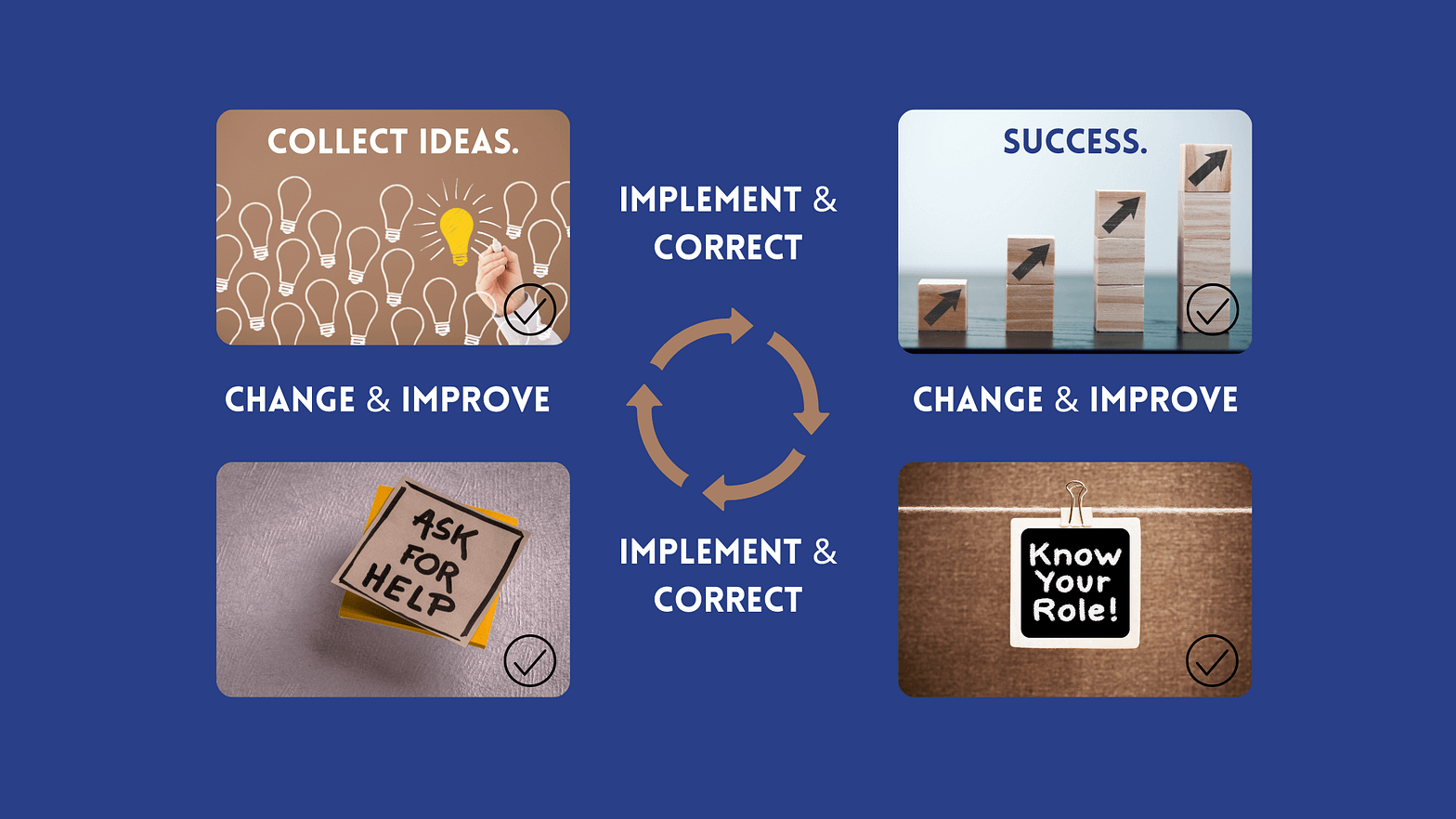
Change is inevitable in any organization: market conditions shift, processes evolve, and people grow. What matters is not whether change happens, but how it is embraced and implemented. Successful transformation is not a leap but a process—one that involves clear roles, open communication, and a consistent approach.
The following section outlines a practical approach that provides guidance: from recognizing your own role to achieving lasting progress as a team.
1. Know your own role
Change rarely fails because of a lack of ideas. More often than not, it fails because of unclear responsibilities and the fact that no one fully understands what role they actually play in the change process.
That's why it all starts with the question:
What role do I play in this process or on this team?
- Am I a source of inspiration?
- Who is driving the implementation?
- A supporter on the team?
- Who should I contact if I have any questions?
- Female decision-maker or male decision-maker?
When roles are clearly defined, it creates a sense of psychological safety: employees know who makes decisions, who provides support, and how feedback is given. This reduces friction and prevents responsibility from “falling through the cracks.”
A helpful tip: Define“who does what”and how decisions are made and communicated. This helps keep change under control.
2. Being able to ask for help or accept help
Many leadership teams and teams believe that change must be achieved “on their own.” But real progress happens when support is actively provided.
Giving help is a leadership skill—and accepting help is a sign of maturity. The two go hand in hand.
In practical terms, this means:
- Get feedback early on, not when it's too late.
- Keep communication channels short: Who can be contacted, when, and how?
- Provide resources (time, prioritization, support, and clearly defined responsibilities).
- Make asking questions a normal part of the process: “If something isn’t clear, it’s a sign that something needs clarification, not a failure.”
Those who are open to help move things along more quickly. And those who are able to accept support reduce stress, improve quality, and increase the likelihood that changes will actually take root in everyday life.
3. Gather ideas from employees
Employees aren't just "doers." They are the experts in day-to-day operations.
That’s exactly where the best insights come from:
What really works? Where are the bottlenecks? Which processes take up time without adding value? What obstacles have been overlooked so far?
To ensure that ideas don't fizzle out, we need structure and recognition:
- Actively seek out ideas (e.g., in meetings, feedback sessions, weekly gatherings)
- Ask specific questions: What went well? What was difficult? What would be a sensible next step?
- Prioritize: Not every idea can be implemented right away—but every idea deserves to be clearly categorized.
- Ensuring transparency: What happens to the contributions? What decision was made, and why?
IMPORTANT: Employees don’t just want to be heard. They want to see their ideas translated into decisions. That is exactly what strengthens commitment and team spirit.
4. Successfully embracing and implementing change
Now comes the crucial phase: actually getting the change underway and making it sustainable.
Successful implementation is based on three principles:
a) Change requires a process-oriented approach—not an “immediate switch”
Expectations must be managed carefully: change doesn’t happen overnight. Depending on the project, its complexity, and its duration, it requires planning, practice, and course correction.
That is why communication is also part of the implementation process:
- What steps come next, and when?
- What is realistic in the short term?
- What will be tested in the medium term?
- What aspects are deliberately left unchanged because they have proven effective or are part of the corporate culture?
This clarity prevents frustration and keeps motivation high.
b) Implementation follows reflection—but not in an endless loop
Reflection is necessary to assess the direction we are heading in. But it must lead to action.
A good goal is:
- reflect on,
- prioritize,
- decide,
- implement,
- check,
- and further develop.
This leads to progress rather than endless debate.
c) Change must be put into practice
A change is only successful when it becomes part of your routine:
- in day-to-day operations,
- in handovers,
- in votes,
- in our interactions with one another,
- and in the way decisions are made.
This is achieved when leadership provides consistent support, facilitates feedback, and highlights successes.
Success is reflected in the numbers.
Whether it's profits, employee turnover, or sick leave: numbers aren't cold and impersonal. They serve as a mirror. They show where the system is currently working and where it needs improvement.
- Consistent profits are achieved when processes run smoothly and decisions are made in a timely manner.
- Low turnover occurs when employees feel that their roles are well-defined and that they are being effectively managed.
- Sick leave is often lower in workplaces where workload, leadership, and working conditions are well-balanced.
Those who talk only of “optimization” but fail to consider success lose their way. Those who focus on success can steer their course with purpose.
At the end of the Improvement Circle, there is more than just a “summary.” It is the moment when change becomes visible—to everyone.
Success is reflected in employee retention.
Employee retention is more than just an HR metric. It’s culture in everyday terms. A team stays together when it understands the purpose, experiences growth, and knows where it stands.
In this context, success specifically means:
- Tasks are clear, roles are defined.
- Feedback is provided before frustration sets in.
- Services are utilized, not merely demanded.
- Leadership that supports—rather than just supervising.
After all, people don’t stay just for the benefits. They stay because they realize: “Here, who I am matters—and my work makes a difference.”
Success is the result of teamwork.
Good teamwork can sometimes seem unspectacular. But that is precisely what makes it valuable. Collaboration becomes strong when conflicts are addressed rather than swept under the rug—and when differing opinions lead to sound decisions.
Successful teamwork means:
- Verification replaces assumptions.
- Responsibilities are clearly defined, not blurred.
- Reflection leads to action, not to endless discussions.
And yes: The same applies here—progress isn’t achieved by “thinking even more,” but by “making clear decisions and sticking with them.”
At the end of the Improvement Circle: Celebrate successes and ensure lasting impact
This involves three steps:
- Celebrate Successes
Every improvement is proof that the process works. Recognize progress in concrete terms, not just in general terms. - Communicating Results
Employees should know:- Where are we at right now?
- What have we changed together?
- What's the next step?
- Explain the joint trip
Stating expectations clearly and early on prevents misunderstandings:- Change and improvement are a process.
- Changes take time—and are implemented gradually.
- Certain things are deliberately kept the same if they have proven effective and fit in with the company culture.
In closing: Saying “THANK YOU VERY MUCH” for your ideas isn’t just a matter of politeness. It’s a form of leadership that strengthens participation and makes the cycle sustainable.
Output – Successfully embracing and implementing change means:
- clearly understand one's own role,
- Allow help,
- Actively incorporate employees' ideas,
- Manage implementation using a process-based approach,
- and ultimately make progress visible.
Change is seen as a source of motivation when processes are refined and improved with clarity and energy, and through collaborative effort within the team.
Success is an integral part of sound business management. Whether measured in numbers, employee retention, or teamwork, success shows you whether your direction is sustainable and makes progress tangible. When leadership uses success as an opportunity for improvement, it creates a work environment where people want to stay and grow alongside the company in a financially healthy way.
If you have any questions about implementing improvements and changes or about specific process areas, please feel free to contact goldWERT _ events & coaching.
Sincerely,
Kathrin Fuchs
Owner & Business Coach at goldWERT