
The most stressful time: successfully mastering Christmas and New Year's Eve

The hotel and restaurant industry is demanding all year round, but the Christmas and New Year period presents a particular challenge. Long opening hours, full restaurants and bars and stressed guests - this is all too familiar for hoteliers and restaurant managers.

How can managers support their employees during this phase?

Here are 3 important but easy-to-implement tools:

1. open communication

Especially in stressful times, it is important for managers to stay in close contact with their team. Regular meetings, feedback discussions and an open ear for the concerns and needs of employees allow problems to be identified at an early stage and solved together. This is the only way to avoid excessive demands.

2. plan days off in advance

Long shifts, short breaks and hardly any time off - this is still part of everyday life during the peak season. This makes it all the more important for managers to keep an eye on compensatory days for their employees. Flexible working hours, sufficient recovery periods and support in balancing work and private life can help here.

3. appreciation and motivation

Praise and recognition are needed to keep employees motivated. Managers should give regular feedback, recognize achievements and show small gestures of gratitude. This strengthens team spirit and gives employees the feeling that they are valued.

Output – The Most Stressful Time in the Hotel and Restaurant Industry

The Christmas and New Year period in the hotel and catering industry is a time full of challenges, but also full of opportunities. With the right support in employee development and an appreciative management style, not only can stressful situations be mastered well, but unforgettable experiences can also be created for guests.

If you have any questions about the hospitality industry or how to prepare for stressful times, feel free to contact me directly or check out my LinkedIn profile.

Sincerely,
Kathrin Fuchs
Leadership Coach & Hospitality Expert

_ goldWERT _ events & coaching
Reflect for more efficient work, for you and your team.

Three key questions can be derived from systemic coaching for reflection in order to ensure more efficient work:

  1. Where do I come from?
    This question deals with the past and helps you to understand your own development and how your current situation came about. What were the triggers for certain decisions and actions? What experiences have shaped me?
  2. Where am I?
    The focus here is on the present. Where am I right now? What are my current resources and challenges? What successes and setbacks have I experienced recently?
  3. Where do I want to go?
    This question focuses on the future. Where do I want to go? What goals am I pursuing? What next steps do I need to take?

There are certainly other questions for reflection, but these 3 round it off very well for me as a business and systemic coach.

How you benefit from reflecting

By reflecting on these three key questions, you can realize the following benefits for you and your company:

  • Clarity and focus: You gain a clear overview of your situation and can concentrate on really important issues. Reflection sharpens your focus.
  • More efficient decision-making: With an understanding of your starting position and your goals, you make informed decisions that lead you purposefully in the desired direction. Instead of acting impulsively, you will be able to take well-considered steps.
  • Continuous improvement: You recognize patterns of behavior that you can adapt to improve your performance and that of your team. Through reflection, you can proactively work on improvements.
  • Motivation and self-reflection: Regular (every 3-6 months) reflection keeps you awake, makes you think about your actions and inspires you to constantly develop yourself further. You create space for creativity and new ideas that benefit your team.

Reflecting for yourself is extremely valuable, but you shouldn't do it too much so as not to put yourself under too much pressure. Reflecting for yourself is one thing, reflecting in a team is another. This should not be forgotten. But what should you pay attention to?

Reflecting in the team

Reflecting in a team is about taking your employees or colleagues on board. A healthy interval between reflections, depending on the project or current process, is between 2-3 months and half a year, similar to individual reflection. The end of the year is just as good a time as just before the summer months, when many people are on their way to a well-deserved vacation. Picking people up before their break brings out the most unspoken issues, so it's a good time to reflect and develop further. At the end of the year, the following questions come to mind:

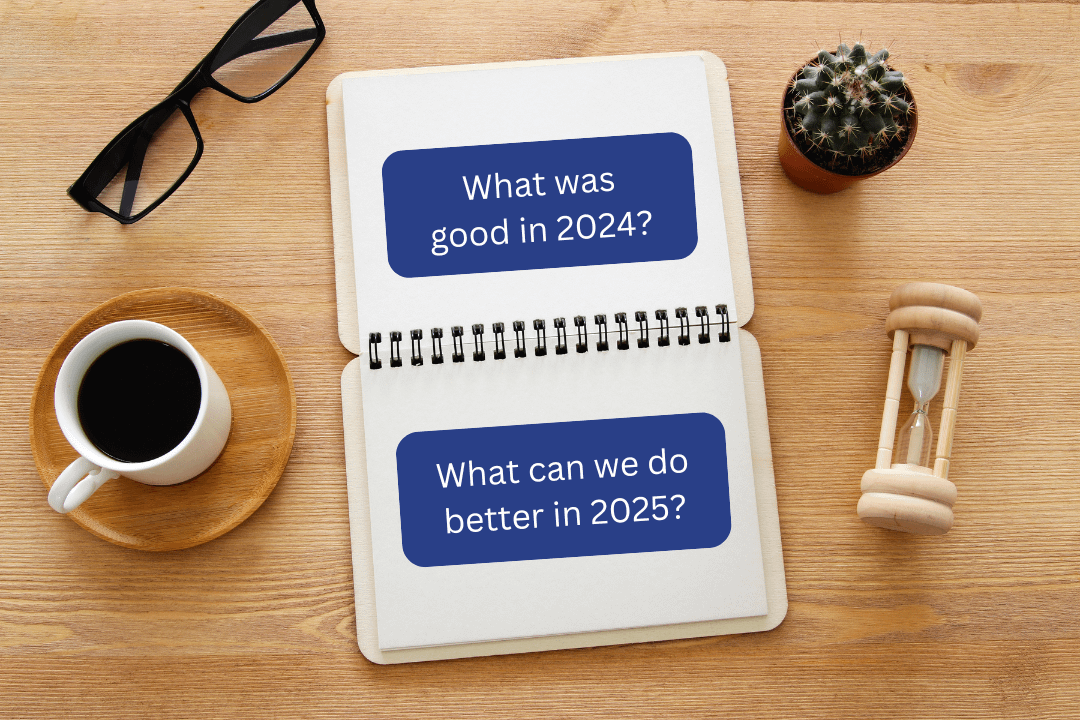
  1. What has (already) gone well in 2024?
  2. What can we do (even) better in 2025?

Reflection within the team is not about discussing everything that did not go well. Projects, processes and weak points should be addressed and defined. Reflection here is synonymous with identifying where there is potential for improvement and what steps we can take as a team to make a positive contribution to improvement. It is essential to look at projects and processes that have gone very well. You can thank your team and draw attention to positive results, thereby motivating your team for what lies ahead.

Output: Reflect on how to work more efficiently—for yourself and for your team.

As a manager, you are constantly required to react quickly and make decisions. This makes it all the more important to regularly take time out to reflect. Use these moments to gain clarity about your situation, review your priorities and focus on the essentials.

Only those who pause can be successful in the long term. So plan the reflection for yourself and your team just as carefully as other appointments. Your company, yourself and your team will benefit from it. By integrating the art of reflection into your leadership style, you not only create a positive working environment, but also encourage your employees to learn independently. In this way, reflection becomes a valuable tool for sustainable success.

If you have any questions on the subject of reflection for more efficient work, team leadership or employee development, please contact me.

Sincerely,
Kathrin Fuchs
Executive Coach

_ goldWERT _ events & coaching

Being empathetic is an essential leadership skill.

For me as a German speaker, it is perfectly clear that empathy is derived from English. We German speakers are often "stubborn" when it comes to different views or being insightful. Ten years ago, being empathetic as a manager and adapting the management style to the respective employee was utopian and alienating for many employees and managers. I know what I'm talking about. I was that empathetic manager. Now I am an empathic business coach and a direct consultant. But what does it mean to be an empathic manager?

Empathy is ...

... the willingness and ability to empathize with the attitudes and behaviour of another person. Synonyms of empathy are sensitivity, sensitivity or compassion. In the past, being empathetic as a manager was still alienating. But how do you lead empathetically in today's world? For many employees, especially the younger generations, empathy is a prerequisite for being a good manager. BUT ...

… why is empathy essential for leaders?

1. empathy as the basis for trust

An empathetic leader creates an atmosphere in which employees feel safe to share their thoughts and concerns. Trust is the foundation of any successful team leadership. When employees know that their manager understands and values their perspectives, they are more willing to communicate openly and actively participate in team development.

2. the role of empathy in employee development

Empathy plays a crucial role in employee development. Managers who are able to recognize the needs and strengths of their employees can create personalized development plans. This not only leads to greater employee satisfaction, but also promotes individual performance.

An effective personnel development concept should therefore include empathetic communication and regular feedback. In this way, managers can actively support the development of their employees and create a positive working environment at the same time.

3. empathic coaching for managers

Executive coaching can help to strengthen empathic skills. In coaching sessions, managers learn how to actively listen, ask questions and give feedback that really resonates. These skills are not only important for personal development, but also for overall team leadership.

Through empathic coaching, managers can learn how to resolve conflicts constructively and positively influence team dynamics. An empathic leadership style can help to avoid misunderstandings and improve cooperation within the team.

4. empathy as a driver for team development

Empathic leadership behavior is a key factor in team development. Teams that are led by empathetic managers often show a higher level of motivation and creativity. When employees feel that their ideas and opinions are valued, they are more motivated and actively participate in the development process.

Empathy also promotes resilience within the team. In times of stress and change, empathetic managers can offer their employees stability and support, which leads to a more stable team structure.

Output: Being empathetic is an essential leadership skill.

Empathy is not a "soft" skill, but an essential leadership competence that has a direct impact on the success of a company. Empathic leadership can strengthen trust, motivation and team cohesion. Companies that invest in the development of empathetic leaders not only benefit from better employee development, but also from a positive corporate culture.

If you have any questions about being empathetic as a manager or would like to develop yourself and your team in this area, please get in touch with me.

Sincerely,
Kathrin Fuchs
Executive Coach

_ goldWERT _ events & coaching

Source: Empathy _ Duden

Spotlight on successful women from the EUREGIO Inntal region.

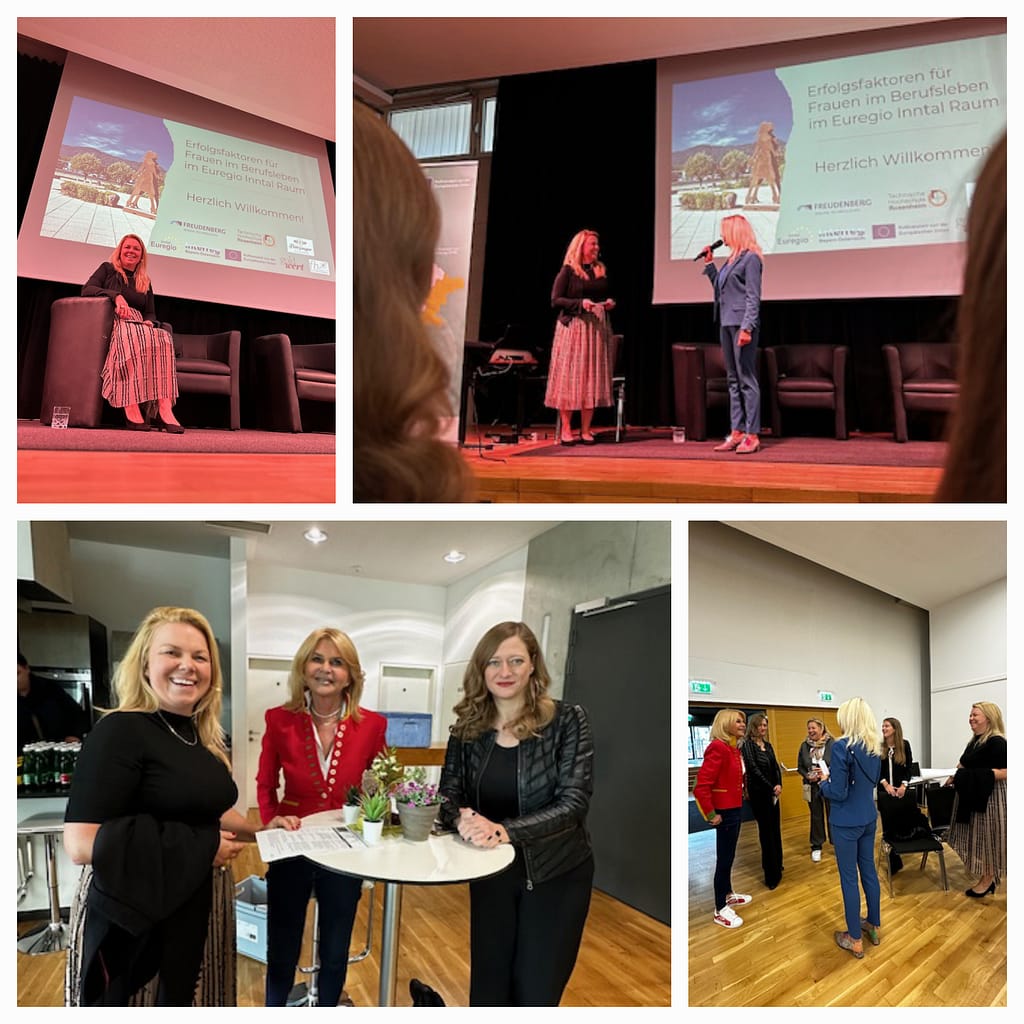
On 16.10.2024 I had the honor and pleasure of interviewing several successful women from the EUREGIO Inntal region on stage at the event "Success factors for women in professional life in the Euregio Inntal region".

As an independent woman, it is very important to me to support and push events that bring the potential of women BEFORE the curtain. This time in the form of a moderation. Working life as a woman is not always easy, although it has to be said that many men don't always have it easy either. In my opinion, too little is said about what is already going well and how to get ahead as a woman. Women should be pushed much more on the positive side and brought into the spotlight. Of course, setbacks are part of it, that's the course of life and also of professional life.

My own career path has not always been smooth sailing and I have sometimes reached my limits. But these limits have sometimes brought me to where I am now; self-employed as a business coach and hotel consultant.

3 Successful Women in the EUREGIO Inntal Region

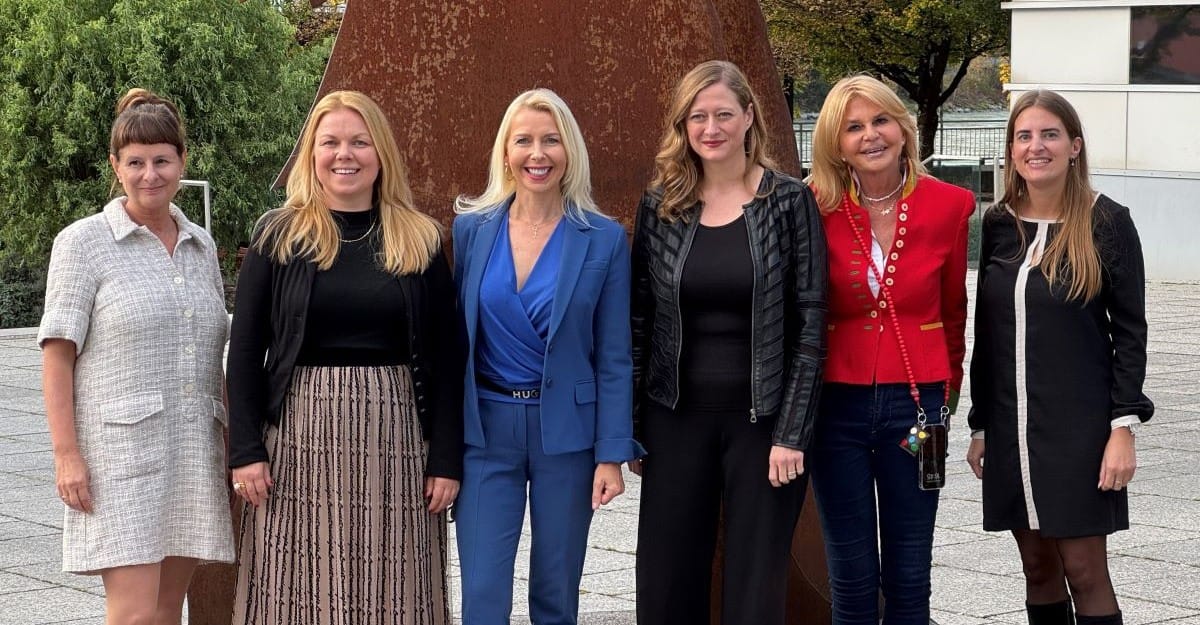
Having the opportunity to interview this impressive group of women, in front of a predominantly female audience, was a very enriching experience for me.

Even during the preparation phase, it became clear to me that these women make a perfect mix for a joint interview, and that each one is unique in her own right:

A woman is sitting on stage at an event about career opportunities for women in the European Union.

Prof. Dr.-Ing. Nicole Strübbe

… a tough and warm-hearted professor in the School of Engineering at TH Rosenheim. She was the first female professor in this school; as of 2024, there are 3 women out of 30 professors. Nicole is also the founder of MINTnetz18+, an organization that focuses on introducing girls to STEM fields. Video (approx. 1.5 min) about MINTnetz18+

Julia Mairhofer, MSc. (Master of Law)

Head of Human Resources at Freudenberg Sealing Technologies in Kufstein, who is open-minded and curious about new things. With her positive attitude, she brings all 500 employees together. She is, in fact, the head of human resources for all three locations in Austria. Video (approx. 1.5 min) about Freudenberg

Marisa Steegmüller

Managing partners of the Flötzinger Brewery—an institution in Bavaria and beyond. At this family-run business, every employee truly is part of the family. Marisa embodies both tradition and modernity in one person. Video (approx. 3 min) about Flötzinger Bräu

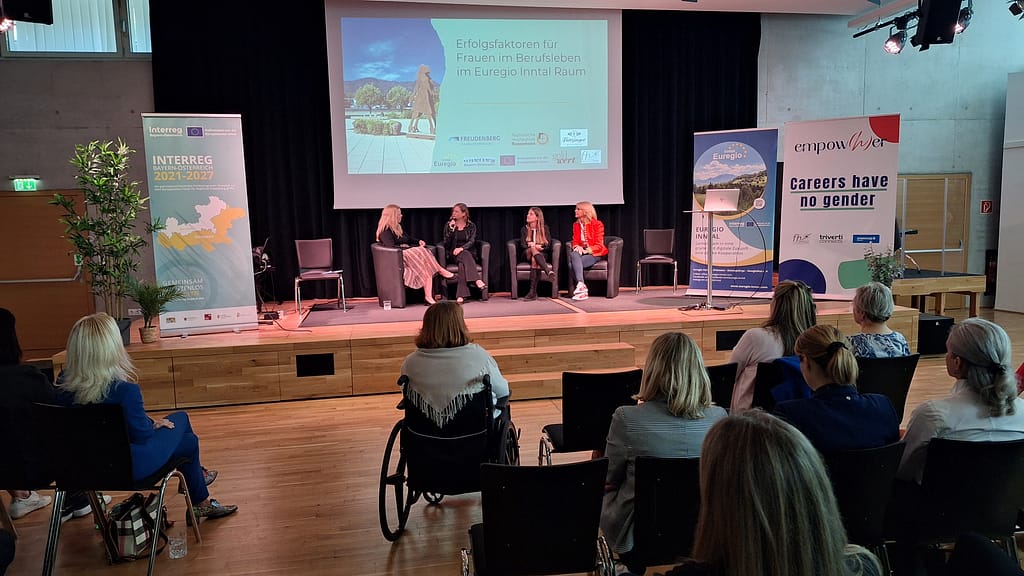
Panel discussion on success factors for women in the workforce in the Euregio Inntal region, featuring a live audience and on-stage presentation.

Three inspiring individuals who lead by example—using their intellect and a great deal of heart—for their employees. Everyone defines success differently, but factors such as fun, enjoyment of work, and a sense of community are essential.

A BIG THANK YOU to Euregio Inntal, Vice President Barbara Schwaighofer, and Managing Director Mag. Esther Jennings, for the exquisite selection of women and for choosing me as the host.

CONGRATULATIONS from me on this women-centered and successful event. Even though there’s still plenty of room for improvement when it comes to gender gaps, there are many positive examples that deserve to continue taking center stage.

All the best, good luck, and see you soon
Yours, Kathrin

_ goldWERT _ events & coaching

You can read a report by Barbara Fluckinger on the event “Success Factors for Women in the Euregio Inntal Region ” at this link.

Feedback culture: how and for what purpose?

A healthy feedback culture is about communicating openly and honestly with one another. Giving and accepting feedback is a key to personal and professional growth.

Feedback culture: personal growth through honest feedback

A good feedback culture is like fertile ground for development. It enables us to openly share and accept both praise and constructive criticism. But how do we achieve this?

Give feedback.

When giving feedback, be specific, appreciative, and respectful. Instead of just criticizing, highlight what went well and where there’s room for improvement. That way, the other person won’t feel attacked but rather motivated. Use “I” statements to express your own feelings without attacking the other person. For example: “I noticed that…” instead of “You always…”.

Accept feedback.

On the other hand, it’s important not only to listen to feedback but also to process it and not take it as a personal attack. It’s a tool for improvement. When you receive feedback, try to view it objectively. Listen actively and ask questions to make sure you understand the points being made. This not only demonstrates your willingness to grow but also shows appreciation for the person giving the feedback. Take time to reflect on it and learn from it. View feedback as a gift that helps you improve. Remember to say THANK YOU for the feedback. And keep in mind: Everyone makes mistakes, and that’s okay.

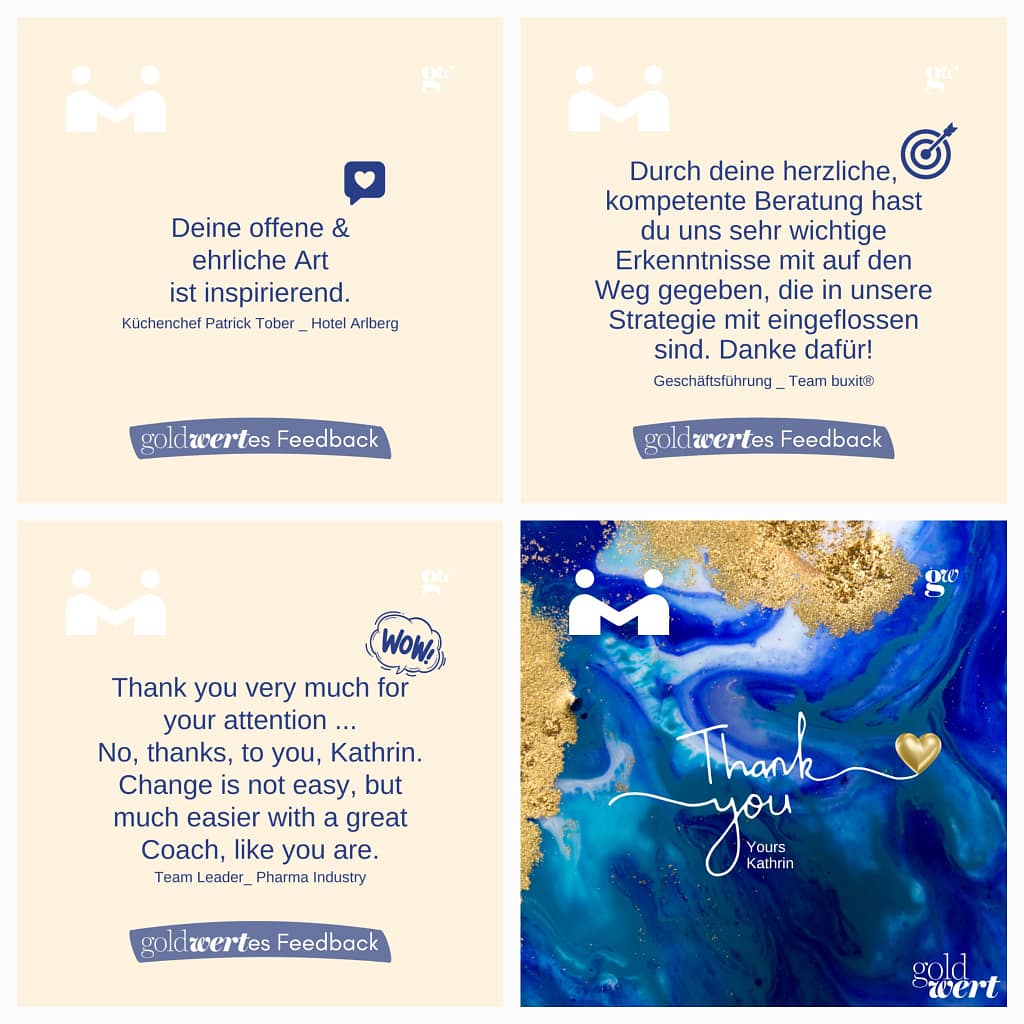
Quotes from various people expressing their gratitude for inspiring feedback.

An open feedback culture promotes trust and team spirit. When we learn to both give and receive, we create an environment in which everyone can grow.

How can you learn to give and accept feedback better?

As the saying goes, practice makes perfect. This also applies to a healthy and open culture of feedback. If you feel that you still have room for improvement in this area—or that giving and receiving feedback could come more easily to you— please feel free to reach out to me, and we can discuss your options during a free introductory session.

Sincerely,
Kathrin Fuchs
Executive Coach

_ goldWERT _ events & coaching

P.S.: You can find a detailed article on feedback culture—Personal Growth Through Honest Feedback—on LinkedIn.

Being authentic as a manager.

The word "authentic" is derived from the Greek authentikos "reliable, correct" or as a person from authentes "originator, doer". On karrierebibel.de 4 criteria of authenticity are mentioned: Awareness, honesty, consistency and sincerity.

I consider myself to be authentic. But what is my definition of “being authentic,” and what does that mean for a leader—or rather, what makes a leader authentic?

As a business coach, what does authenticity mean to me as a manager?

Here are a few points that I consider essential for authentic leadership:

Being Human

Share your feelings, impressions and what you consider to be valuable interpersonal input for the company. If you sense that an employee is not feeling well, take the employee aside for a one-on-one conversation. Please don't talk about it, especially not in front of others.

Being able to give and accept feedback

Many managers ask for feedback, but don’t know how to handle it—or can’t handle it at all. Not even when it’s positive feedback. Giving feedback should be a constructive and empathetic process for both parties. Especially when suggesting improvements, please don’t act on impulse—unless you’re already very skilled at doing so in a respectful manner.

Be transparent

Employees should be committed to a company and identify with its philosophy. However, if the employee does not know where the company's journey and goals are heading, the employee is unfortunately left in the dark. Your employees want to know what's coming next, inform them about it and not just the day before. Please. And "LAST but NOT LEAST":

Be honest and trustworthy

Being honest with yourself and with others requires awareness and living your own values, philosophy and vision. "Trust has to be earned." ... as a manager, however, you should give your employees the benefit of the doubt. I know you will be disappointed more often than not, but trustworthy employees will thank you for it. Being skeptical doesn't help anyone.

These are the 4 cornerstones of "being authentic" for me. But what does Generation Z say?

Generation Z demands that their managers be "authentic".

Being authentic has to do with being down-to-earth, grounded, and genuine. It means being yourself without putting on a facade. It also means being open about it when you’re not feeling well. Even leaders are allowed to have bad days—we all do. However, they must be stronger than their employees. That is one of the qualities a leader who serves as a role model should possess.

A collage featuring the word "Authentic," along with a definition, signs bearing the terms "Fake" and "Genuine," and an artistic illustration with the message "Know Yourself."

Read more about "Next Generation and Leadership"?

… as I mentioned in my summary following my most recent guest lecture at Munich University of Applied Sciences. There, I spoke with the students about what they expect from a leader. Follow the link (the first link is in German, the second in English).

Questions or suggestions about being authentic?

If you see "being authentic" differently, or if you have any questions, comments or additions to the blog article "Being authentic as a manager", please contact me directly.

Sincerely,
Kathrin Fuchs
Executive Coach

_ goldWERT _ events & coaching

Sources: Wissen.de _ Authentic, Karrierbibel.de _ Authenticity

The podcast for the hotel and restaurant industry.

The hotel and restaurant industry is the most beautiful industry we have. That's why I like to use my podcast to support hoteliers and restaurateurs who want to talk about their corporate culture , share their development and increase their visibility .

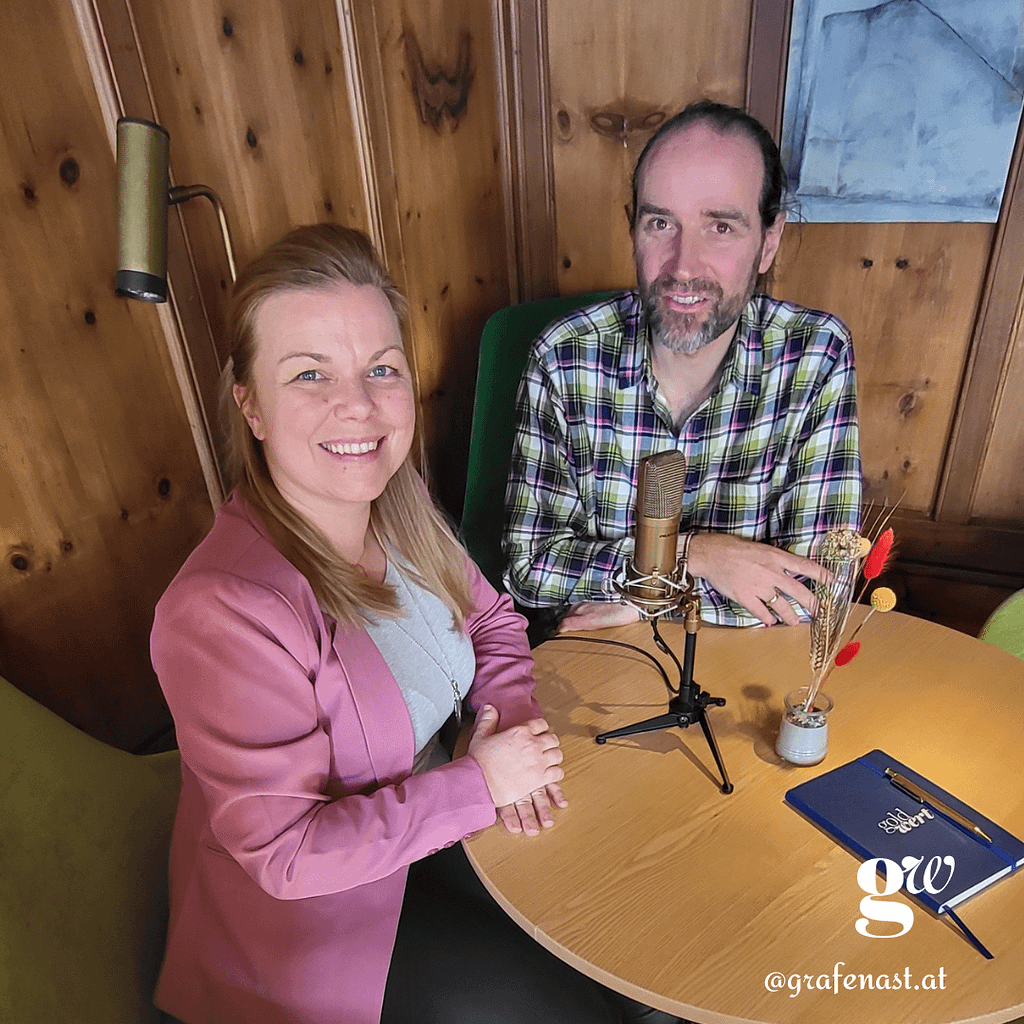
Two people are sitting at a table in a wood-paneled room, in front of a microphone. The woman is smiling; she is wearing a pink blazer and has long, blonde hair. The man is wearing a plaid shirt and has a beard. A floral arrangement and a notebook are visible on the table.

GOLD _ your podcast with _ VALUE

We talk about the staff, the philosophy, and what makes each hotel or restaurant unique. Young people, in particular, find podcasts very appealing. Be sure to check out GOLD—your podcast with _ WERT, the best for employer branding.

If you want to use the podcast medium as a mouthpiece for your corporate and employee culture or improve your visibility and audibility, here are the steps to a goldWERT podcast episode.

6 steps to a goldWERT podcast episode

  • Feel free to check out my website or listen to my podcast episodes to see if we share similar values and ideas.
  • Feel free to contact me directly by email— Kathrin Fuchs—goldWERT —or schedule a time for a no-obligation introductory meeting— Calendar—goldWERT —to discuss the specifics of the podcast episode.
  • Podcast Recording _ It’s IMPORTANT to me to highlight the positive and unique aspects of your business. That’s why I’ll check in for one night (or two nights if my travel time is three hours or more) to observe your processes and work methods and take photos.
  • We record the interview on the day of departure. In my intuitive interviews, I ask questions about the company’s values, its philosophy, and—above all—its employees.
  • After the interview is recorded, it takes about 4 weeks on average for the podcast episode to go live. You'll receive links to embed the podcast episode on your website, job portals, or elsewhere.
  • One joint post is planned for social media (LinkedIn and Instagram) in 2026.

These were the 6 steps that lead to the goldWERT podcast episode.

Click here for the latest episode on Spotify:

Cooperation with Great Place to Work

Great Place to Work certified customers receive a 10% discount on their goldWERTe podcast episode.

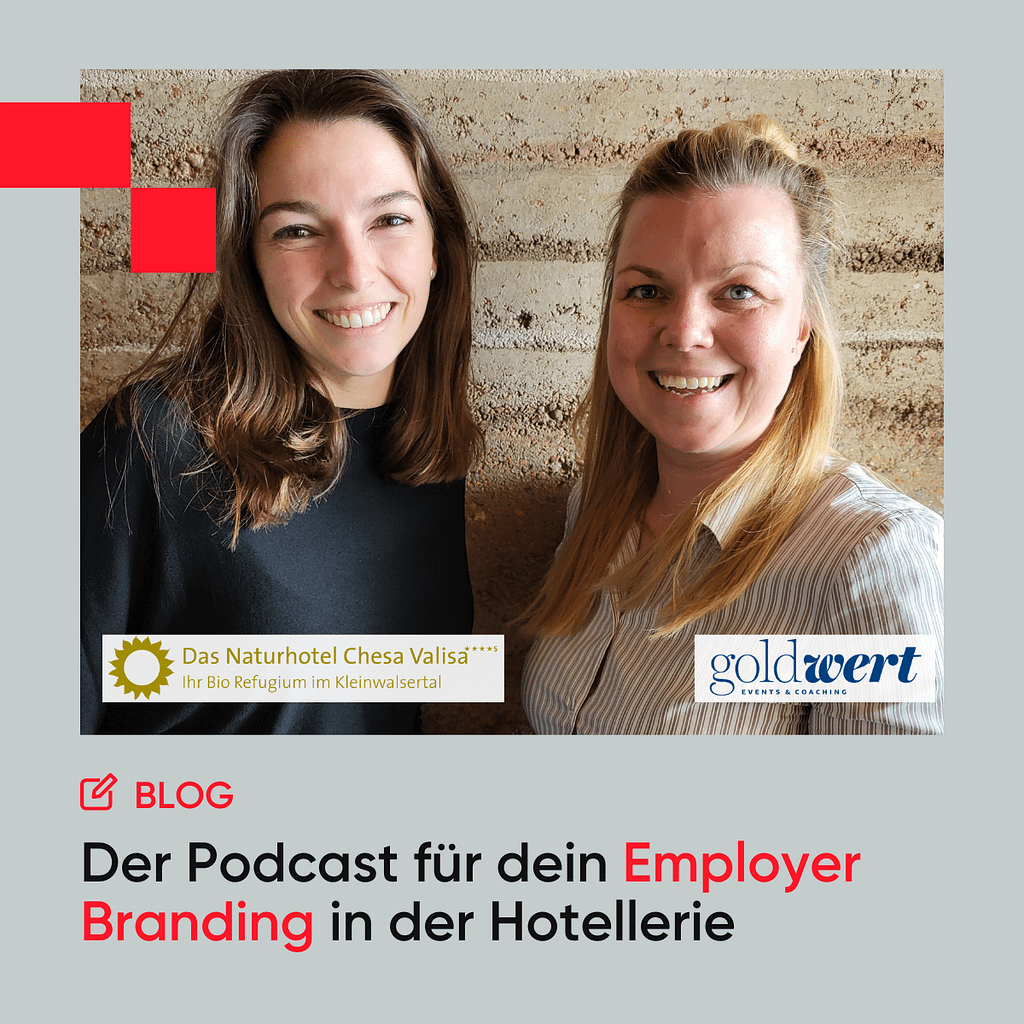
Podcast episode with the Naturhotel Chesa Valisa.

If you have any questions about the podcast or would like to use other goldWERT services, please contact me directly or have a look at my portfolio.

Sincerely,
Kathrin Fuchs
Executive Coach & Hotel Expert

_ goldWERT _ events & coaching

The Key to the Perfect Match in the Workplace.

“Not every employee is a good fit for every company. And, likewise, not every company is a good fit for every employee.” by Kathrin Fuchs

Two people are shaking hands in a stylish setting.

How the Right Employee Strengthens the Company.

A company’s success depends largely on how well its employees and corporate culture align. But what helps in finding the perfect match when recruiting employees? In the hospitality and restaurant industries, as well as in many other sectors, this is of great importance.

But how do you find that perfect match?

One possible innovative approach is the podcast“GOLD _ your podcast with _ WERT.”At a time when the job market is becoming increasingly dynamic and companies are competing more intensely for skilled workers, it’s more important than ever not only to find the best talent, but also those who are the perfect fit for the company. ly, enhancing a company’s appeal as an employer is a crucial factor here. And what role do podcasts like “GOLD _ your podcast with _ WERT” play in this?

The key to the perfect match: employer branding and more

Employer Branding: The Company as a Brand

Employer branding is more than just a stylish logo and an appealing careers page. It’s about authentically communicating the company’s culture, values, and mission. Strong employer branding helps attract the right candidates and retain them over the long term. Companies that position themselves clearly and emphasize their uniqueness stand out in the competitive job market.

The Impact of Podcasts on Employee Recruitment

Podcasts are a powerful tool for reaching potential employees. They allow companies to tell stories from within the organization, share employees’ success stories, and provide deep insight into the work culture. “GOLD _ Your Podcast with _ VALUE” is an excellent example of how companies in the hospitality and restaurant industry can communicate their values and visions. The podcast discusses topics such as team leadership, profitability, and people-centered leadership—issues that are particularly relevant in this industry.

Combining Team Leadership and Efficiency with a Human Touch

Another crucial aspect in the search for the perfect match is the style of leadership. Companies that lead with a human touch create an environment where employees feel comfortable and can reach their full potential. Such a leadership culture not only promotes employee well-being but also boosts the company’s profitability. In “GOLD _ Your Podcast with _ WERT,” these topics are discussed in a practical manner and enriched with valuable tips for real-world application.

Output: The Key to the Perfect Match in the Workplace.

Finding the perfect match when recruiting isn’t an easy task, but it’s an investment that pays off in the long run. Strong employer branding that authentically and clearly communicates the company culture, combined with modern communication tools such as podcasts, can help attract and retain the right talent. Companies that also prioritize a human-centered and economically sound approach to team leadership create a work environment where employees are not only satisfied but also productive.

Do you have any questions about "Perfect Match" in the employee search process?

Or would you like to find out more about how you can strengthen your employer brand? Then get in touch with me or listen to one of the podcast episodes and form your own opinion. I look forward to helping you and finding the best solutions for your company together.

Sincerely,
Kathrin Fuchs
Executive Coach

_ goldWERT _ events & coaching

Focus and teamwork after the break.

How you and your team can get back to work motivated and focused.

It's not easy to get yourself going again and again. Especially after a break, many people find it difficult to stay motivated and focused on new tasks and goals. It is difficult to regain motivation and focus on new projects.

With a few simple tips and tricks, you and your team can get off to a successful and motivated start:

Reflective Practice

A good starting point is to reflect on the last few months:
- What worked well?
- What challenges did you face?

Leadership coaching and team coaching can be valuable tools here. By reflecting together with your team on past successes and failures. You can also gain valuable insights and work on targeted improvements.

Self-Assessment and Self-Motivation

After the break, it’s important to assess yourself realistically.
– What are your goals for the coming months?
– What motivates you personally?

By honestly assessing yourself, you can work specifically on building your self-motivation. Tip: Setting small, achievable goals and regularly checking your progress will help you stay motivated.

Effective Team Leadership

A motivated team is at the heart of every successful company. As a manager, it is your job to bring your team back together and motivate them after the break. Team leadership plays a central role in this.

Tips: Schedule team meetings to set new goals together and discuss how to assign tasks. Create a positive and supportive work environment where everyone feels comfortable and valued.

Combining Economic Efficiency with Humanity

Profitability and humanity should go hand in hand. Efficiency and productivity are important, but the needs and well-being of employees should never be overlooked. A human management style based on openness and empathy not only promotes team satisfaction, but also contributes to long-term profitability.

Output: Focus and Teamwork After the Break

The start after the break doesn't have to be a tough battle. With reflective work, honest self-assessment and effective team leadership, you and your team can approach new tasks with motivation and focus. Remember that humanity is just as important in leadership as efficiency. In this way, you can create a positive and productive working environment in which everyone feels comfortable and can give their best.

Do you have any questions?

… or if you need help getting back on track after your break, let me know and get in touch. Together, we can develop the best strategies for you and your team and get off to a successful start in the second half of the year.

Sincerely,
Kathrin Fuchs

_ goldWERT _ events & coaching
Coaching - when and for what?

As a business and systemic coach, I recommend preventive coaching so that I can help you in just a few hours. While fewer hours may seem counterproductive to my business, they are part of my philosophy. Of course, there are also options for coaching after a conflict has occurred.

A conflict, a clash of different characters or unspoken issues that drag on for weeks can cause a bang.

coaching-leadership-coaching-teamcoaching-teamwork-economy-humanity-goldwwert

"Everyone is capable of helping themselves."

We all have it within us: the ability to interact with different people, accept other opinions, or simply let our colleagues be who they are. However, every one of us needs a little nudge in the right direction from time to time—to find the right words that empower the person we’re talking to. This is often part of my coaching sessions: raising awareness about different team members and choosing the right words.


Preventive coaching

Preventive coaching can offer many benefits, especially in a professional context. Executive coaching and team coaching are two key elements that contribute significantly to improving teamwork and leadership. How does preventive coaching help?

1. to recognize and resolve conflicts at an early stage.

Regular coaching sessions ensure that potential conflicts within the team are identified and addressed at an early stage. This promotes a harmonious working atmosphere, improves collaboration and prevents escalation.

2. teamwork and efficiency are increased.

A well-coordinated team that knows what to look out for in communication and how best to work together is much more productive and successful. Establishing clear communication and understanding and optimally applying the strengths of each team member is sometimes addressed in coaching.

3. to lead with humanity.

Executive coaching helps managing directors, executives and managers to lead their employees with empathy and respect. Human and goal-oriented leadership strengthens trust and motivation in the team, which in turn has a positive impact on the company's key performance indicators.


Coaching after the conflict

An argument, the dismissal of a team member or the escalation of a manager; there are often moments at work that nobody expects. And it is often only after an incident that you realize that something is not running smoothly. How can coaching help after a conflict?

1. conflict management and conflict resolution.

After a conflict, it is important to understand the causes and find sustainable solutions. As a coach, I can act as a neutral and external expert and help the parties involved to have constructive discussions.

2. rebuilding trust and relationships.

After a major conflict, interpersonal relationships in the team are damaged. Rebuilding trust and creating a positive working atmosphere is supported by goldWERT coaching.

3. realignment and motivation.

After a crisis, the team often needs a new direction and new motivation. I can help you define common goals and rekindle the team spirit.


Output: Coaching—When and Why?

Coaching is a valuable tool for moving teams and managers forward - whether before or after a conflict. Preventive coaching helps to avoid conflicts and create a positive, productive working environment. Coaching after a dispute helps to rebuild trust and motivation in the team.


Do you have any questions?

… or if you’d like to learn more about the possibilities of coaching, please let me know or schedule a no-obligation introductory meeting in my calendar. Together, we’ll find the best way to help you achieve your goals and strengthen your team.

Sincerely,
Kathrin Fuchs
Executive Coach

_ goldWERT _ events & coaching