
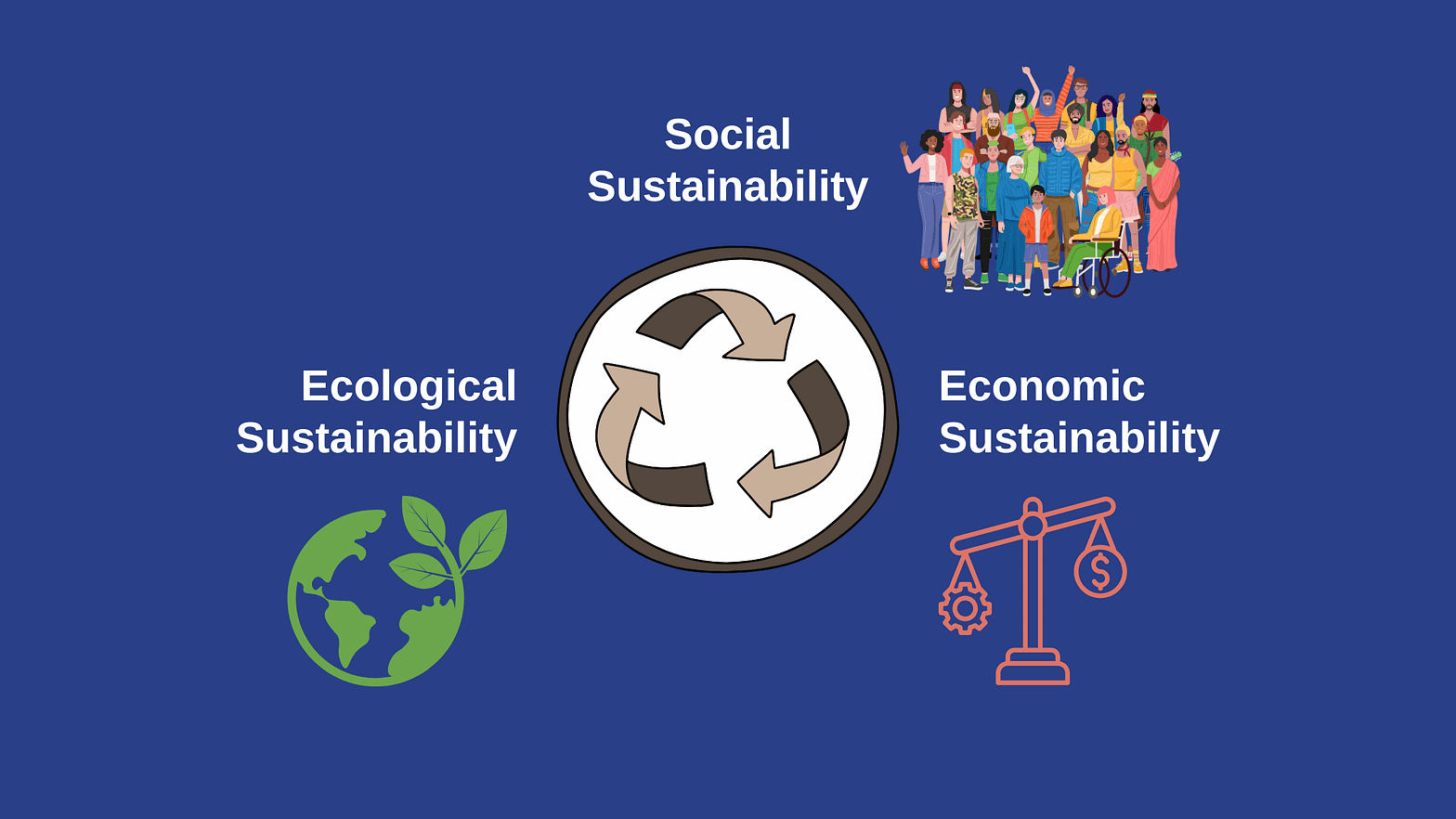
Sustainability is an entrepreneurial approach that is indispensable now and will be for decades to come. The three pillars of sustainability - economic, ecological and social - form the basis of a holistic concept that not only protects the environment, but also promotes economic success and social responsibility. Read the following article to find out how sustainable working is changing everyday life and which aspects managers should consider when implementing it.
The three pillars and their significance for managers.
Economy: economically strong and future-oriented
The economic pillar deals with the creation of profitable business models that achieve both short-term and long-term success. Sustainable companies consider not only profit, but also the environmental and social impact of their actions. This means working in a way that conserves resources, operating efficiently and maintaining strategic partnerships.
As a first step, managers should integrate sustainability goals into the corporate strategy. Investing in green technologies or innovative products can pay off in the long term and set the company apart from the competition.
Ecology: Responsibility for the environment
Environmental sustainability requires a more conscious approach to the consumption of resources. Companies that promote environmentally friendly practices such as recycling, using renewable energy and minimizing waste make a decisive contribution to the fight against climate change.
It is important to take concrete measures for implementation. For example, training courses on resource conservation can be held for employees to raise awareness of environmental challenges.
Social issues: focusing on people
The social pillar relates to the well-being of employees and responsibility towards society. A company that values social sustainability offers fair working conditions, promotes diversity and supports the community.
Managers should establish a corporate culture that fosters team spirit and appreciation. This can be achieved through regular feedback meetings, team-building measures and training opportunities. Satisfied employees are more productive and loyal, which has a positive impact on business success.
Sustainable impact in everyday working life
Sustainable working represents a fundamental change in operational procedures. It promotes a new way of thinking that prioritizes innovation and efficiency. The introduction of digital processes and communication tools can significantly reduce the consumption of resources. A paperless office or the elimination of business trips in favor of digital meetings are concrete steps in this direction.
In addition, the introduction of flexible working models can not only improve employees' quality of life, but also reduce the ecological footprint. Home office options, for example, reduce commuting and therefore emissions.
Recommendations for managers
As a manager, you should keep an eye on a few key aspects in order to run a sustainable company:
- Integration of sustainability goals: Set clear, measurable goals and integrate them into your corporate strategy. Regular reviews help you to recognize progress and make adjustments if necessary.
- Employee participation: Actively involve your employees in the process. They provide valuable ideas and suggestions that contribute to improving the sustainability strategies.
- Investments in green technologies: Prioritize investments in resource-saving technologies that combine economic efficiency and environmental awareness in the long term.
- Open communication: Share your sustainability strategy with all stakeholders to create transparency and promote trust.
- Appreciation and community: Create a culture that promotes appreciation and community. Targeted personnel development measures increase employee motivation and reduce staff turnover.
Output - thinking sustainability holistically within the company.
Sustainability is a corporate responsibility that has far-reaching positive effects. By integrating the three pillars of sustainability into your corporate strategy, you not only create a more sustainable working environment, but also position your company for the future in the market.
As a manager, you have the opportunity to actively make a difference. Invest in economic efficiency, take care of ecological issues and focus on social responsibility. The future belongs to companies that have the courage to act sustainably and focus on their employees.
If you have any questions about sustainable working or the integration of sustainable aspects into your company, please feel free to contact me.
Sincerely
Kathrin Fuchs _ goldWERT
#coaching #holistic #consulting #social #economic #ecological #sustainability #goldwert
Thank you very much for your comments. I don't know enough about the common good economy, so it would be presumptuous of me to give you a tip. But I understand very well that you want continuous improvement and question things more than you used to. You can decide for yourself where your personal end point is and when it's enough. I always say that you should do what feels good for you and what is within your reach. I love my work, but every now and then I need a break to recharge my batteries for my individual and team coaching sessions. Good luck finding out.
Thank you for your valuable contribution! Now everyone should understand why sustainability is not only sensible for ecological reasons, but also necessary for economic reasons. With this in mind, thank you for the knowledge you share here!
Thank you very much for your comment, which I am very pleased about. I follow the principle of "sharing is caring" and I'm glad I was able to give you some input. Is there another topic you would like to learn more about?
What a beautiful principle 👍.
During my professional career, I was responsible for the quality system in drug safety in a global company in a managerial position. At that time, the principle of "continuous improvement" applied. I was quite ambitious and - perhaps to the chagrin of some colleagues in Operations - therefore not very flexible in dealing with ethical and legal requirements.
After my job, I discovered the motto "as much as you need".
I wanted to give the continuous improvement an end point, a goal to interrupt the "more and more". Do you understand what I'm getting at? It's about thinking seriously about what condition could be sustainable enough to reduce the frequency of changes required. Today I often say "this has to last 100 years, otherwise I won't buy it."
That's a topic that interests me - in my garden it's permaculture. What is it in the company? Are you familiar with the economy for the common good? Is there a theoretical / philosophical basis?